Wokingham’s news from The Mercury 1913-1923

Wokingham’s ‘Coat of Arms’

Jim Bell continues his journey to provide us with an overview of Wokingham during the 19th and 20th centuries. This time he visits the archives to extract  Wokingham’s news from old Reading Mercury newspapers. They go as far back as 1859 (see post), but we start here just before the Great War.

1913 Saturday, 1st March

The Wokingham Picture Palace will be formally opened on Tuesday afternoon next and invitations have been sent to the leading residents of the district. A charge will be made for admissions and a share of the proceeds will be given to the Crowthorne & District Nursing Association. The Directors will provide light refreshments. The first public performance will take place the same evening.

1913 Saturday, 15th March

Electric Theatre (Wokingham Picture Palace)

The opening of this place of amusement took place on Monday afternoon. The Mayor (Councillor W. T. Martin) opened the proceedings and switched on the first film. Mr. Vince, a director, thanked the Mayor for his kindness. A selection of films was then exhibited. The theatre was filled at the evening performance

1914 Saturday Jan 17th

Fire Brigade Wedding – At St. Paul’s Church on Monday, Mr Weston B Martin, son of Mr & Mrs H Martin of Denmark Street, was wedded to Miss Margaret Emily Smallbone of St. Leonard’s, Wokingham, only daughter of Mr S Smallbone. The bride was attended by Master Joey Dearlove, who acted as page dressed in fireman’s uniform.

The bridegroom was driven to the church in a fire engine accompanied by the brigade including the Marquis of Downshire (who acted as driver) and Lord Hillsborough. Mr Martin has been a member of the brigade for 23 years and that body presented him with a clock. A reception was afterwards held at Fernleigh, home of the bridegroom’s brother.

1914 Saturday Feb 14th

Alderman Heron’s wife died Thursday last week at 22 Market Place.

1914 Saturday May 9th

Motor Fire Engine for Wokingham. Lady Downshire holds bazaar

1914 Saturday June 5th

Mr W Chambers, Sergeant at Mace died in Australia. (Sydney Daily Telegraph 28th April) Taralga. William Chambers who arrived recently from England, died suddenly at the Goodbron Hospital today. The late Mr W Chambers was well-known as a caterer at Wokingham and Wellington College. He served in the Volunteers and retired with the rank of sergeant. He was for about 20 years, a ‘Sergeant at Mace’ and Sidesman at St. Paul’s Church. He had advised his friends of his intention of returning home.

1914 Saturday Sept 26th

Lady Eustace died.

Lt. Frederick de Vere Allfrey, 9th Lancers, only son of Frederick Vere Allfrey and grandson of Mrs Bruce of Arborfield Court, was killed aged 22. He was shot by a wounded German after he had dismounted to extract a lance from a wounded comrade’s leg.

1914 Saturday Oct 17th

Fire Call. On Sunday afternoon the Fire Brigade received a call from Eversley and within 14 minutes were at the scene of the fire. A store in the occupation of Mr. Dearlove was burnt down, but the efforts of the brigade prevented other damage.

1914 Saturday Oct 24th

A matinee was given at Wokingham Picture Palace on Tuesday in aid of the Belgian refugees. The well-known bass, Mr. Berry, sang “The Battle Hymn” assisted by a chorus, and later the “Bugle Call”. The directors have much pleasure in handing over £5 to the fund.

1915 Saturday Jan 23rd

Death aged 80 of Mr Gotelee, well-known stationer and bookseller of the Market Place which had occurred on Wednesday morning. The deceased who was blind had been failing in health for the last three years. He was a good chess player and was noted for his kindness and will be greatly missed. The funeral is arranged for Saturday at St. Paul’s Church.

1915 Saturday April 17th

Members of the local fire brigade met on Monday evening and presented Fireman Lord Hillsborough with a firemen’s axe of silver steel (chased) with an ebony handle suitably inscribed on the occasion of his Lordship attaining his majority. Deputy Captain Caiger made the presentation.

1915 Saturday June 26th

On Tuesday the Fire Brigade received a call to a Heath Fire at Crowthorne. Within a few minutes of the alarm the firemen were off in the new motor fire engine, and were soon at the scene of the outbreak which they were able to cope with successfully.

1915 Saturday July 24th

The members of the local Fire Brigade have appointed Lieut. A Goswell Hon. Sec., and appointed Mr. E V Robinson the Hon. Treasurer in place of Sergeant H Watts, who is now serving in the Berks Yeomanry.

1915 Saturday Sept 4th

Wokingham Fire Brigade applies for extra room in the Town Hall.

1916 Saturday Jan 8th

Dr T B Bokenham of Broad Street has been elected by the Committee of St. Paul’s school managers as one of the foundation managers in place of the late Mr T E Ellison.

1916 Saturday April 8th

The Earl of Hillsborough, elder son of and heir of the Marquis of Downshire entered his 23rd year yesterday having been born on April 7th 1894. His Lordship held a commission for a short time as 2nd Lieut. In the Berks Yeomanry but recently resigned on account of delicate health.

1916 Saturday April 22nd

Miss Vera Allfrey only daughter of Mr & Mrs Vere Allfrey of Ashridgewood married Capt. Francis Anderson of Little Harle Tower, Northumberland.

Was Fireman W S Medcalf a councillor.

1916 Saturday Sept 9th

The popular manager of the Electric Theatre (Mr A P Stevens) having been called to the colours, the directors have appointed Mr F S Perkins of Wokingham to fill the vacancy.

1916 Saturday Nov 18th

Wokingham Fire Brigade under the Captain, the Marquis of Downshire and Deputy Captain, F Caiger.

The following were elected:

Town Crier: Mr J Taylor

4 Honorary Constables: R W Turner, W H Wilson, W Pearce, A Jervis.

Srgt at Mace: C Sparkes

Medals and a bar were presented to three members of the Fire Brigade:

Eng F G Martin for 20 years’ service

Eng F Knight for 20 years’ service.

Eng. W B Martin who already received a medal for 20 years, received a bar representing five years.

1917 Saturday 14th April

T B Bokenham was sidesman at St. Paul’s Church.

1917 Saturday 21st April

F W Saulez of Wixenford was appointed to the vacancy at Lucas Hospital caused by the death of Rev J Stratton.

1917 Saturday 14th July

Mr C Trill, motor car proprietor of Peach Street received news on Tuesday that his eldest son Clarence had been killed on the 7th instant in an explosion. He had attended the council schools and on leaving there was employed by Messrs Sales & Son. He had only joined up in the Royal Navy five months previously.

1917 Saturday 4th August

Extract from Palmer School annual treat article—The members of the Wokingham Fire Brigade attended as usual with their engine for the purpose of boiling the water required for the tea.

1917 Saturday 17th Nov

Death of Lieut Cockerell

1917 Saturday 24th Nov

Miss Julian Roberts died suddenly at 5, The Terrace at the age of 80 years. She was the eldest daughter of John Roberts. Her brother was town clerk and father was alderman. She was hon sec of Wokingham Habitation of the Primrose League. She was buried at All Saints on the following Saturday. Two of the mourners were Mrs Basnett and Miss Helen Roberts, sisters.

1918 Saturday 25th May

CSM Alfred Jeffcock Rifle Brigade was killed in action on the 25th of March at the age of 21 years. He was the youngest son of  Mrs Jeffcock of 21, Easthampstead Road. His rapid promotion was noted. His brother is wounded and his father died a few months ago.

1918 Saturday 3rd August

Lieut. Allan H. Perkins, Pioneer Battalion, Australia Forces (Queensland) youngest son of H H Perkins of the retreat married Miss Elsie Adelene Pither youngest daughter of Mr & Mrs T B Pither of Broad Street. Her sister Daisy attended.

1918 Saturday 7th September

Lieut. Col. Hills Nicholson awarded DSO by the King

Death and Funeral of Alderman D N Heron

1918 Saturday 12th Oct

Death of Lieut. Col Hills Nicholson

1918 Saturday 16th November

W T Martin appointed Deputy Mayor

The following were elected:

C Sparkes Sgt at Mace

J Taylor Town Crier

Honorary Constables: A J Rodgers, E Jefferies, N W Turner and W H Wilson.

1919 Saturday 8th March

The Town Hall accepted the portrait of Alderman Wescott from his widow.

1919 Saturday 5th April

At a meeting of the town council held on Thursday the General Purposes Committee reported the receipt of a communication from the authorities offering a German howitzer as a war trophy for the town.

1919 Saturday May 24th

Mr Cathrow Martin has recently been admitted a Freeman of the City of London

1919 Saturday 31st May

The captured gun presented to the town arrived on Tuesday. It is a 120mm German howitzer and presents a very battered appearance. The gun was captured by the 12th Division on the 27th July 1917 and claimed by the 5th Royal Berks. Regiment.

Tithe Barn is the residence of Col. Leslie Wilson GMG DSO MP.

1919 Saturday June 7th

The Borough Surveyor reported that a 120 mm howitzer had been received from the War Department and was temporarily stored in the Town Hall yard. The question of the provision of a site was deferred for further consideration.

Dr Bokenham is to leave Wokingham.

1919 Saturday July 26th

Wokingham Peace Celebrations

1919 Saturday Aug 2nd

Children’s Peace Celebrations

Presentation on Thursday evening last week at the Fire Brigade Station. Dr Bokenham, for 17 years Hon Surgeon to the Wokingham Fire Brigade, was presented by the members with a case of pipes on his leaving the town. Chief Officer Caiger introduced the object of the assembly. There were present the Mayor, the Deputy Mayor and Mr. A T Heelas.

The Mayor spoke in terms of appreciation of  Dr Bokenham’s work, and regretted the reason of his leaving the town, namely, the state of his health.

1919 Saturday Sept 20th

Notification has just been received from the military authorities by Mr & Mrs Treaacher of The Lodge, Embrook House, late of Keep Hatch, Wokingham that their son, the late Driver Frank Treacher, RFA who died a prisoner of war is buried in the prisoner of war cemetery at RAGHTCHE?, Asia Minor 20 miles NNW of  Aleppo.

1919 Saturday Nov 15th

The following were elected: C Sparkes Sgt at Mace.

1919 Saturday Dec 6th

The late Alderman Heron’s wine and spirit business of 40 years has been re-opened after extensive alterations as Heron’s Wine Vaults by Messrs Fergusons Ltd of Reading.

1919 Saturday Dec 13th

Mr A T Heelas has been elected a foundation manager of St. Paul’s Schools in place of Dr Bokenham.

1920 Saturday Feb 7th

Free Churches to purchase burial ground near Skew Bridge, Reading Road

1920 Saturday Feb 28th

Fire Brigade hold social in town hall.

1920 Saturday May 8th

Duke of Connaught’s daughter died.

1920 Saturday Nov 6th

The General Purposes Committee recommended that the shell presented to the War Savings Committee be placed in the corridor of the town hall. Alderman Hughes having kindly offered to supply a base.

1920 Saturday Dec 18th

Presentation to Supt. Goddard and of medals and certificates to the men. – see photocopy.

1921 Saturday Jan 22nd

The trustees for the Nonconformist burial ground have been appointed by the Mayor.

1921 Saturday Feb 5th

An inscription has been fitted to the shell presented to the War Savings Committee.

1921 Saturday Feb 26th

The Nonconformist burial ground was dedicated.

1921 Saturday April 9th

C B Middleton & Co. has taken over the mill of Mr. F C Heelas and established a knitting factory. The factory began on Tuesday. There are handknitting machines and a large winder operated by water turbine.

1921 Saturday June 2nd

All Saints War Memorial was unveiled and dedicated on Monday.

1921 Saturday Aug 20th

Richard Herring dies

1921 Saturday Nov. 12th

Councillor Blake was appointed Mayor with Alderman Sale as Deputy Mayor.

Also elected were:

Sgt. C. Sparkes as Sergeant-at-Mace

E Jeffries, W Pearce, A Jarvis and H Dyer as Honorary Constables.

James Taylor as Town Crier.

1922 Saturday Sept 23rd

Dorothy Dearlove elder daughter of Mr & Mrs G J Dearlove died suddenly aged 25.

The tannery in Barkham Road for many years in the occupation of Messrs Philbrick and latterly Harry Grace Ltd was offered for sale at the Rose Hotel. The bidding ceased at £2,300 after which the auctioneer announced that he must bid on behalf of the vendors. This he did and the property was bought at £2,500.

1922 Saturday Nov 14th

Alderman Blake was re-elected mayor with Philip Sale as deputy mayor.

1922 Saturday Dec 9th

Vacancies in the fire brigade have been filled by E P Osmond, W W Stewart, C F Mason and R Maddams.

1922 Saturday Dec 16th

FLYING TOO LOW. AIRMAN FINED AT WOKINGHAM

An interesting case was heard at the Wokingham County Police Court on Tuesday when an airman was fined for flying at too low an altitude over the town. A summons for trick-flying over the town was dismissed. The proceedings the first of their kind for Berkshire were taken under the Air Navigation Orders.

The defendant, Sidney Frank Woods, a young airman with considerable war experience in various parts of the world, was staed to be now in the employ of the Berkshire Aviation Company which arranged for a series of passenger flights  and air tricks during the past week at Wokingham. His address was given as “Hillside” Lilleshall, Salop and he was summoned for breaches of  Air Navigation Orders by reason of the low altitude was the cause of unnecessary danger to persons below and also with carrying out trick-flying over a town area both on December 6th. He pleaded not guilty and Mr. A F Clark (Reading) defended.

Mr Clark asked for the names of the persons to whom danger was caused. Supt. C Goddard said danger must have been caused to hundreds of people but he would give the names of himself and four constables.

Supt. Goddard produced the Order which stated that trick-flying must not be carried out over any city or town area or any populous district, nor must aeroplanes be flown at such a low altitude as to cause unnecessary danger to persons or property. At 2.30 pm on Wednesday, November 8th, he said, he was in the police station, when an aeroplane went over at such a low altitude that it seemed to skim Mr Barry’s house. It made a tremendous noise and had there been a timid horse in the street it was more than probable that it would have been alarmed. He had heard that some sort of trick-flying was to be carried out having seen bills to that effect in shop windows. He went towards the meadow where he understood the landing was to be, and at All Saints Church he noticed that another flight was taking place. The aeroplane came over him and was lower than the tower of All Saints’ Church. Finding that the meadow was rather further away than he thought he turned back to send a constable on a bicycle. He returned to the Market Place at 3.00 pm and again heard a tremendous noise and looking up he saw the aeroplane come over Barclay’s Bank. Until it came over those premises he could not see it. It turned and after rising a little nosed down into a vertical position and turning again returned in the direction from which it came, namely Buckhurst Farm. Later it returned over Broad Street at an exceedingly low altitude and when it had travelled over a shop he could not see it. At the time when it was over Palmer Schools the children were dispersing and had it crashed two or three hundred children would have been in danger.

Cross-examined by Mr. Clark Supt. Goddard would not agree that it was a difficult matter to estimate the height at which an aeroplane was flying

Defendant was flying at the height of the weather vane at the top of the Town Hall. He did not know that defendant was carrying an altimeter neither has he asked to inspect it. Defendant was unable to show his licence but he was not charged with that.

Mr. John B Holmes, a director of the company, who was commissioned as a pilot during the war in 1918 said he was with the Defendant on December 6th. His company had been taking the public for flights during the past four years. The defendant did not perform any trick-flying that afternoon but had turned vertically or “banked” – a necessary operation. It was extremely difficult to judge the height of an operation but they were carrying an altimeter which never registered below 1,600 feet a height at which, should the engine fail , it would give ample scope to reach a safe landing.

The chairman said that the Bench were of the opinion that there was no trick-flying and that the case would therefore be dismissed. The Bench thought, however, that defendant was flying too low and the punishment which could be inflicted for that offence was a fine of £200 and six months imprisonment . For this the defendant would be fined £1.

1923 Saturday March 24th

Death of Howard Palmer

1923 Saturday April 21st

The Wokingham War Memorial Clinic in Denmark Street was opened on Tuesday afternoon by the Marchioness of Downshire.

TOWN HALL

We noticed a few weeks ago the efforts made for the purpose of erecting a new clock on the turret of our Town Hall. After the committee had decided upon accepting the tender of Mr Tucker of London for the erection of the clock and the funds necessary had been generously contributed by the inhabitants and their friends a strong desire was expressed by many of them that the new clock should strike the quarter hours. The estimate has consequently been amended by the addition of the necessary works to carry out what certainly appears to be a great improvement on the original and this includes three bells which are considered requisite. It will alter the amount to £100 and has been collected. We trust that all intending subscribers will at once forward their donations.

Posted in All Posts, Aspects of War, Jim Bell's Wokingham History | Tagged , , | Leave a comment

Wokingham News from Reading Mercury 1859-1868

Wokingham’s ‘Coat of Arms’

Jim Bell continues his journey to provide us with an overview of Wokingham during the 19th and 20th centuries. This time he visits the archives to extract  Wokingham’s news from old Reading Mercury newspapers. They go as far back as 1859:

1859 – Sat 1st Jan

Messrs Weight and Barford of Wokingham are appointed surgeons to Wellington College. Mr. Barford who was formerly demonstrator of Chemistry at St. Bartholomew’s Hospital is also appointed to deliver an annual course of chemistry lectures to the college students.

1859 Sat 29th Jan

Wellington College was opened for students on the 20th January.

1859 Sat 5th Feb

Wellington College was opened by Queen Victoria. (P8)

1859 Sat 4th June

A presentation of inkstand to W C Beechey at the Rose Hotel on the occasion of the dissolution of the Society of Oddfellows to which Mr Beechey had been Honorary Secretary for 15 years. The Chair was occupied by Edward Weight.

1860 Sat 31st March

The preliminary steps for the formation of Wokingham Rifle Corps were taken –30 volunteers entered their names. The corps is part of Forest Division Rifles.

1860 Sat 23rd June

New Town Hall  On Monday last the Savings Bank weekly meeting was held for the first time in the room in the new Town Hall, the use of which for bank purposes in the trustees perpetuity. The room, which is in the corner of the new building facing the Rose Hotel, is large and in every way suited for the bank purposes and there the bank will be opened every Monday as usual from 12.00 till one o’clock.

1860 Sat 30th June

NEW TOWN HALL

The looking glass presented by theRecorder Mr. Carrington, on the opening of the new Town Hall was a plate 21” by 91”. It was supplied by Mr. Edward Foulkes, Russell Street, Covent Garden.

1860 Sat 4th August

Death of F A Carrington Recorder

BAPTIST CHAPEL.

The work of demolition of this building was commenced on Tuesday last, and we hope the weather will prove more favourable for the erection of the new building than we have lately experienced. Mr. Wells of Reading has undertaken the contract. The Town –hall has been kindly given up for the purpose of holding their Sabbath morning and evening services; but although a spacious building it does not appear sufficient to accommodate the number of attendants.

EXCURSION TRAIN TO HASTINGS

The Special Excursion Train to Hastings on Tuesday last, was well patronised by our townsfolk, in connection with the members of the Reading Philanthropic Institution. The weather was fortunately fine, and those who made up their minds for a holiday thoroughly enjoyed it.

1860 Sat 18th August

Biography of F A Carrington

Literary Institute occupies new Town Hall

1860 Sat 1st September

THE WEEKLY HALF HOLIDAY MOVEMENT

The public meeting to which we alluded last week, was held on Monday last in the Town Hall, but was not very largely attended, still we noticed present the Alderman (J.L. Roberts Esq.) Captain Gower. The Rev. W. Hirst, Messrs W.W. Wheeler, F. Soames, J. Soames, J. Heelas, jun., J. Weeks, H. Ifould, W.W. Burr, W. Hollis, R. Briginshaw, and others.

The Alderman on taking the chair, explained the object of the meeting called in pursuance of the requisition to him; after which, Captain Gower, Mr. Weeks. Mr. F. Soames and Mr. W. Wheeler addressed the meeting, and the following resolutions were carried:- 1st.That it is desirable to set apart some time from business during each week, in order to afford to the inhabitants of the town and neighbourhood, the means of recreation necessary for mental and physical improvement. 2nd. That a committee be formed for the purpose of waiting on those whose influence it is important to secure, as to the practicability of carrying out the foregoing resolution, and also what time in the week would be most convenient, and that the meeting be adjourned until Wednesday, the 12th of September to receive the report of the Committee.

It seemed the general opinion that although it might not be practicable to entirely suspend business at any particular period, still if it all would but earnestly second the movement, the opportunity could be easily afforded to everyone of availing themselves of a few hours of weekly recreation.

1861 Sat 5th Jan

J G Barford marries

1861 Sat 6th July

Baptist Chapel was opened on Thursday 4th July.

1862 Sat 6th Sept.

The foundation stone of St. Paul’s Parish Church was laid on Tuesday by Mrs. John Walter.

1862 Sat 13th September

A BALLOON DESCENT

On Thursday afternoon between five and six o’clock our town was thrown into a state of excitement by the news of the near approach of Mr. Green’s Balloon, which had ascended from Reading that afternoon. In a short time almost everyone turned out to watch with interest the huge aerial visitor and it soon became apparent that the travellers intended to affect a landing near.

They first reached terra firma in a clover field on the farm of Mr. Edward Allen, near the church, and were soon surrounded by a very numerous assemblage, when finding that it might occasion a good deal of damage to the crop the balloon was towed to a large meadow where plenty of assistance being rendered by the bystanders, Mr. Green and his fellow traveller alighted in safety and in a very short time the gas was allowed to escape and the unwieldy balloon, to the astonishment of those who had never before had an opportunity of seeing such a thing, was soon safely picked up with the car, and taken off in a cart without sustaining the least damage.

1862 Sat 6th Dec

James Twycross died on Wednesday

1864 Sat 16th April

Opening of All Saints Parish Church on Friday 15th April after renovations.

1864 Sat 6th August

WATERING OF WOKINGHAM STREETS

During the past week, through the energy of a few of our tradesmen, a capital improvement has been introduced in our town: we mean the partial watering of our streets. At present the water-cart only visits the Market-place, and a short distance down the adjoining streets, but when the inhabitants experience the benefit derived, we shall hope to see the improvement extended.

One or two previous attempts in former years have failed, the more credit is due to those who have successfully started the project new, and when it is seen that where all combine how small an individual weekly subscription is required to continue this present plan, it surely will not be discontinued, especially during the present dry and dusty summer.

Some complain that the supply of water is rather scanty, but they must bear in mind that the supply is in exact proportion to the subscription, and an increase in the latter item will at once secure an increase in the former.

1864 Sat 22nd Oct

THE WOKINGHAM FIRE ENGINE

The larger engine which is kept at the Town Hall has lately undergone extensive alterations and repairs, and for this purpose Mr. Merryweather of the firm of Merryweather and Sons, (of Long Acre and Lambeth) attended to suggest what repairs and alterations were necessary. Mr. Alderman Ferguson ordered that these should be at once carried out, and consequently the engine was sent to Messrs. Merryweather’s fire-engine works in London.

The engine has been mounted on springs which makes it travel much easier along the roads. The works have been thoroughly overhauled and repaired, and the firm have turned it out equal in power to those of their latest design. The engine is painted a bright red colour, and on each side in gold letters is written the word “Wokingham”. Several new lengths of hose, fire buckets, &c., have also been provided , and in addition to those, a domestic fire pump, a small inexpensive article, which can be instantly set to work by a single person, and is invaluable in extinguishing fires when they have not obtained much hold on the place.

When the other engine is repaired, the townspeople may flatter themselves they have sufficient power to soon extinguish any fire that may occur.

1864 Sat 26th Nov

J L Roberts was chairman of the Literary Institution

1865 Sat 8th July

John Balston Walter, son of John Walter III, has been Gazetted to a Lieutenancy in the Royal Berks Militia vice Baynham removed.

1865 Sat 11th November

On Wednesday night a ball was held in the Town Hall under distinguished patronage and was numerously attended by the principal families resident at this end of the county together with numerous officers from Aldershot. The party numbered rather more than one hundred and the hall was very tastefully decorated by Mr. W Chambers to whom was entrusted the refreshment department which, as usual on those occasions gave the greatest satisfaction. Burnham’s quadrille band performed a choice  selection of music and the party did not separate until 4.00 on the following morning.

1865 Sat 9th Dec

On Tuesday the Royal Forest Lodge of Oddfellows celebrated their first anniversary with a soiree in the Town Hall. The Chair was taken by Alderman Heelas.

Sat. 30th Dec 1865

The coming of age of the Earl of Hillsborough.

On Tuesday night the hills on the farms held by the tenants of Castlereagh Estate were illuminated with tar barrels, bonfires etc. The Craighah Hill was rendered conspicuous by a grand display of fireworks consisting of several flights of rockets with various smaller pieces. For miles around the illuminations were visible several farm houses being brilliantly lighted.

1866 Sat 13th January

The festivities at Hillsborough Castle in celebration of the coming of age of the Earl of Hillsborough continues—

On Tuesday evening the tenants of the Kilmarlin Estate to the number of 600 partook of the hospitality of the Marquis of Downshire and amongst the enjoyments provided for them witnessed a private theatrical performance in an elegant little theatre expressly fitted up in the mansion. Other amusements are in contemplation.

Sat. 24th Feb 1866

On Thursday last the Churchwardens and Overseers of Wokingham distributed nearly forty tons of coal amongst the poor parishioners from the funds realised from the fuel allotments  – a most acceptable gift just now when the weather is colder, and from the long continued wet weather the poor have not been so fully employed as usual.

1866 Sat 23rd June

GENERAL HOLIDAY

In the early part of the past week a requisition was set on foot by a number of the inhabitants who were desirous that a general holiday should be kept on the Coronation Day, which very quickly received the appeal of all the principal tradesmen of the town, and on Thursday it was presented to the Alderman, Mr James Skerritt, who promptly issued a hand bill, in which he recommended his fellow townsmen to carry out the proposal on Thursday next by closing their shops and suspending business as far as practicable.

We shall hope to see so reasonable request very generally complied with and thus enable the employer and employed to enjoy the rare treat of a day of recreation in this beautiful summer season, a boon, the value of which can only be realised by those whose duties tie them daily to the counter or desk.

1866 Sat 7th July

The stoppage of the Town Clock during the past few weeks has been a source of inconvenience to many and it has also been complained very generally that lately the clock has not kept much correct time as formerly, a fact in no way surprising when we state that the clock when first placed in the Town Hall was an old one.

The alderman has since called to his aid a church and turret clock manufacturer of London who recommends the erection of a new clock having four faces which would cost but little more than the recent repairs to the present one.

The proposal to adopt the latter plan must strike everyone as being the best. The alderman has accordingly called a meeting of the inhabitants of the afternoon next when the specifications and estimations and measures taken we trust to raise the necessary funds to carry out the plan determined on.

1866 Sat 24th Nov TOWN CLOCK

The completion of this much – improvement during the past week has afforded great satisfaction to the townspeople. The clock strikes the quarters, the hour faces have been painted black with gilt numerals and hands which enables the time to be observed at a much greater distance than formerly. The clock has been manufactured by Mr. E. Tucker, of Theobold Road, Grays Inn. The cost, including the new bells, has been upwards of £100 raised by voluntary subscriptions.
1867 Sat 2nd Feb

A new clock and bells have recently been erected in the Town Hall the changes attendant upon the same having been defrayed by public subscription collected under the superintendence of Mr. Alderman Skerritt. The clock shows the time upon four dials and strikes the quarters and hours upon bells weighing about 4 hundredweights cast by Messrs. Steinbank & Mears of Whitechapel. The clock itself has been constructed by Mr. Tucker of Theobold Road, London on the horizontal bed principle and embraces all modern improvements.

1867 Sat 27th July

Court “Leo” in connection with the London United District, was opened on the 17th inst., by Brother Cotton, the District Chief Ranger, at the “Hope and Anchor” Inn, Wokingham, assisted by the Brothers Hancock, Herbert, House, Moultry, Aldridge &c. The favourable state of the weather enabled the Brothers and members of the new Court to march in procession through the streets, headed by the town band playing popular airs and halting at the residences of several gentlemen who promote the welfare of the Order. On their return everything was admirably arranged and the new Court was formally opened by the District Chief Ranger and Brothers when twenty-five members were made and ten propositions received after which Brother Cotton delivered an interesting address to the new members upon the principles of Forestry, its rise and progress, and its present position as compared with other societies,-its amalgamated number of Courts and members and its sound financial position. At the conclusion the room was thrown open and a large party assembled and spent a pleasant evening.

House Moultry, Aldridge, &c. The favourable state of the weather enabled the Brothers and members of the new House

1867 Sat 3rd Aug

A marriage has been arranged between Lady Alice Hill and Lord Kenlie, son of the Earl of  Earl Rective (Bective?).

1867 Sat 19th Oct

BLIND CHARITY

On Wednesday the Corporation met at the Town Hall to distribute the charity of the late Mrs Sarah Yarnold who left £20 yearly to four blind persons-two men and two women-those residing in Hurst and Ruscombe to be preferred. There were numerous applications and the following were elected: William Alder of Hurst, Charles Waite of Reading, Lucy New of Woodley and Ann Mellet of Swyncombe, each receiving five pounds.

1867 Sat 26th Oct

For some time past the good people of Wokingham (like the numerous letter writers to the London journals) have been vainly trying to ascertain the reason of the wide difference between the wholesale and retail price of meat. However, last Saturday evening the Town Crier announced that an enterprising West End butcher would sell any joints of beef for 6d per pound and a thriving trade he drove ere he closed his shutters he had sold out. He appears as well satisfied with the results that he announced his intention of repeating the experiment.

1867 Sat 9th Nov

COUNTY BALL

On Wednesday evening our Town Hall presented a most animated scene on the occasion of this ball being held. The room had been very tastefully decorated and at ten o’clock dancing commenced to the music of Burnham’s Band, and the party which numbered 120 was composed of the principle county families in this neighbourhood, and included a numerous sprinkling of officers from Aldershot. Everything passed off most satisfactorily. The refreshment department as usual in the hands of Mr. W. Chambers of the Market Place receiving the unqualified approval of  the company.

THE LITERARY INSTITUTION

The “season” of this institution will be inaugurated on Thursday evening by an address from John Walter, Esq., who will also give particulars of his recent tour through the United States. The particulars are advertised elsewhere.

FAIR

This Annual November Pleasure Fair was held on Saturday and Monday last when there was the usual motley assemblage of shows, stalls and itinerant exhibitions, and as the weather was fine each day there was a large attendance , especially in the evening. Some of the inhabitants feared that as the fair extended over Sunday the usual quiet of the town on that day would be disturbed, but it was not so as a more orderly fair we do not recollect.

On Sunday afternoon the Rev. J. W. Charlton, the Incumbant of St. Sebastian’s, held a special service in the Market Place, and delivered a most suitable address to an audience most exclusively of the fair people, who listened to the rev. gentleman with marked attention.

There was no case calling for the attention of the magistrates arising from the fair. The police keeping a close watch on the few suspicious characters observed.

1868 Sat 1st February

On Saturday evening the town alarmed by the cry of “Fire”. It appears that a shed in the yard of the Red Lion Inn, in the middle of the Market Place, is used by the landlord, Mr Mattingly as a carpenter shop, and the upper part as a skittle alley. About half past nine flames were discovered in this shed. Plenty of assistance being at hand the doors were kept closed and water poured in from the roof by which judicious means the flames were subdued before much damage was done although a quantity of tools were destroyed. The fire no doubt was the result of an accident.

1868 Sat 28th March

VISIT OF THE PRINCE OF WALES

On Friday, the 20th inst. The meet of the Queen’s staghounds was fixed for Wokingham and in the morning it was rumoured tat we were to be honoured by the presence of the Prince of Wales, and this rumour was soon confirmed by the arrival of the Prince’s horses. The hounds arrived in the Market Place shortly before the appointed time and were met by an immense field of horsemen estimated at upwards of three hundred besides many ladies and carriages.

Exactly at twelve o’clock the Princes, accompanied by his Equerry, Captain Ellis, arrived in a carriage and pair, and having alighted at the “Rose” Hotel, he mounted his favourite chestnut hunter and proceeded through the streets amidst the hearty but respectful greetings of the assemblage to a meadow below All Saints’ Church, where the deer, the celebrated “Doctor,” specially reserved for this occasion was uncarted.

The Prince looked remarkably well and repeatedly acknowledged the cheers of the assemblage. The “Doctor,” directly he was at liberty, bounded off in the direction of Bracknell, but being  headed he turned into the grounds at Buckhurst and from thence went on through Billingbear to Shottesbrook park at a great pace; at the last named place he got into a pond and a check ensued which was most welcome to such of the field as were still in the hunt.

The “Doctor” was safely taken near Taplow, after a good run. Three gentlemen only were up at the finish. The casualties were numerous, and the Prince had several falls,- one soon after starting, his horse, owing to the giving-way of a rotten bank, falling with him. He was, however, immediately up and mounted again, with no worse result than a mark of Berkshire mud on his scarlet coat.

ENTERTAINMENT

On Tuesday evening Mr. Wade Clinton gave a farewell reading at the Town Hall, assisted by some musical friends, and a very excellent programme was issued. The attendance was not so large as at Mr. Clinton’s previous readings, but those present were certainly well entertained and the musical pieces especially were rapturously applauded.

1868 Sat 11th April

COUNTY BENCH 6TH APRIL (Before John L. Gower, Esq.)

James Donnelly of Westminster, London, slipper maker, was brought up in the custody of Supt. Millard charged with feloniously stealing thirteen pieces of copper wire netting from the stained glass windows of St. Paul’s Church, Wokingham, on the night of the 1st February last, the property of the churchwardens. The prisoner and his brother have been  for a number of years engaged in robbing the wire guard work from the exterior of illuminated windows of  and the prisoner was sentenced to four years penal servitude for this offence in January 1864. It will be remembered that on the morning of the 7th ult, two constables of the Reading Borough Police stopped two men near the Great Western Railway Station  with a quantity of copper wire in their possession when one of them made his escape. The prisoner was apprehended by the superintendent of police at Wolverhampton in Staffordshire on the 3rd instant, and has been identified as the same man who then escaped. Supt. Millard applied for a remand until Wednesday, which was granted.

1868 Sat 6th June

ODD-FELLOWS’ FETE. On Whit-Monday the members of the new “Royal Forest” Lodge of Odd Fellows, No. 5066, celebrated their anniversary at Matthew’s Green, near Wokingham, the seat of Captain Elliott Morres. A procession, headed by the Reading Saxe Horn Band, paraded the town, and then proceeded to the Park.

At one o’clock an excellent dinner was provided under a spacious tent, the caterer being Mr Newcombe, of the “Hope and Anchor” Inn, Wokingham. John Walter Esq., presided, and was supported by – Walter Esq., the Rev. T J Browne, the Rev. T Morres, Capt. Morres, Dr. Barford, Dr Waite, Mr Munden, Mr Westcott, &c. – After dinner the loyal toasts were proposed by the Chairman, and Captain Morres and Lieutenant Walter responded for the “Army and Navy”. Mr Robert Blake, the secretary, then read the report from which it appeared that the Lodge was founded in 1862 with only thirteen members. The numbers have been gradually increased until this year they have reached 137. The receipts this year amounted to £4 10s and the expenditure to £3 2s.; but the total value now is £209 19s 8d., of which £190 2s. 11d. is in the Post Office Savings Bank. Eighteen members have been initiated during the present year.

The other toasts were – “The Bishop and Clergy,” “Success to the New Royal Forest Lodge,” &c. The Chairman said that if agreeable next year he should be happy to find a convenient place for the society at Bear Wood if they decided on paying him a visit. (Cheers.)

After dinner a variety of games were commenced and the festivities concluded  with a ball at the “Hope and Anchor.”

1868 Sat 20th June

During the past week a movement has been set on foot in Wokingham to provide two or three hours of relaxation each week during the summer months for the assistants in the various business establishments to whom the enjoyment of the pleasant summer weather will be a boon much appreciated. It is arranged to close the shops at five o’clock every Wednesday (commencing next week) and from the unanimous feeling shown in favour of the scheme there is no doubt of its being generally adopted as the whole of the principal tradesmen have given their consent and it is especially gratifying to know that the plan originated with a few of the employers and not from the employed – a proof of kindness and consideration which will be truly valued.

The plan, we hear, has been adopted in various other places with the success and, where all join, the benefit is shared by all, and no one suffers in a business point of view.

1868 Sat 4th July

The holiday on Coronation Day was kept here on Monday last when we were glad to see the shops all closed, and early in the morning numerous pleasure parties might be seen wending their way in various directions, all bent on enjoying their annual summer day’s holiday. Many availed themselves of the excursion train to the seaside, a large party went to the fete at Whiteknights, some to the Crystal Palace, while others followed out their various ideas of pleasure in fishing parties, cricket matches, and other sources of amusement.

All returned home very tired, but very happy, and we have little doubt much the better for the enjoyment of the fresh air and the beautiful weather, to apply themselves with renewed energy to their business avocations, so rarely interrupted in so pleasant a manner.

1868 Sat 5th September

TREAT TO WORKMEN

On Tuesday last the men employed by Mr Allaway, builder of Wokingham, had their usual excursion. The place chosen this year was the Crystal Palace on account of the Great Temperance Fete which took place on that day, most of the men being teetotallers.

Everything went off successfully and the men were well satisfied with their day out.

1868 Sat 19th September

TOWN HALL

The Town Hall is now being thoroughly repaired and decorated by Mr Frith of this town and when completed will no doubt present a very nice appearance. The interior has not yet been renovated since the building was first completed.

1868 Sat. 24th October

SANGER’S CIRCUS This immense company paid a visit to this town last Saturday where their parade through the principal streets excited much interest and admiration. The camels and elephants were especially attractive. There were two performances during the day; that in the morning was pretty well patronised and in the evening the tent was thronged.

The performances were excellent throughout and the feats of the equestrians and acrobats, and the Arab troupe were particularly astonishing.

1868 Sat 31st October

WINDSOR FOREST TURNPIKE. This trust will expire tomorrow (Sunday) at twelve o’clock at which hour the gates will be thrown open, and no further tolls taken, and as soon as practicable, the toll houses, side bars, and other property of the trustees will be sold and cleared away. The future repair of the road will fall on the various parishes through which it passes.

1868 Sat 12th December

GALE BLOWS DOWN ELM TREE. The terrific gale of Sunday night laid low an object of much local interest in the town – the fine old elm tree near the Roe Buck Inn, in the Market Place, which was regarded as a great ornament. The tree fell about half past one in the morning with a loud crash arousing many of those living near from their sleep. It was fortunate the disaster happened in the night when there was no one about and also that it fell towards the centre of the Market Place. Formerly there were several elms in Broad Street but they have disappeared one by one until the tree in the Market Place alone remained as a relic of past ages, and the theme of many’s a tale of hairbreadth escapes when on bull-baiting days our forefathers occasionally had to scramble into the friendly tree for safety.

Posted in All Posts, Jim Bell's Wokingham History | Tagged , | Leave a comment

Hills Nicholson family: Four sons lost in two World Wars

Edward Hills Nicholson 1880 – 1918. One of four brothers killed by war.

The Nicholson family have no Wokingham street or building named after them and have sunk below the consciousness of today’s local community. In the 1800’s however, they lived in what is now the Cantley House Hotel and they invested in large parts of Wokingham. It is also the tragedy of war which took away this family’s youngest generation. The Nicholson’s were wealthy, connected and self made; they were also destroyed by both World Wars. Local historian Jim Bell provides Wokingham Remembers with an excerpt from his book ‘Five Wokingham Families’:

‘Edward Nicholson and his wife, Sophia Hill, hailed from Northumberland. Son of William a butcher, and Margaret Nicholson, Edward was born in Hexham and she in North Shields. They had married in 1846 and, five years later, Sophia gave birth to Eliza Henrietta. In the following year she had a son, Alfred James. At that time Edward described himself as a draper. He must have been quite successful for they had two servants.

To understand how the Nicholson family moved from a butcher’s shop to owning large

Frederick Walton, inventor of linoleum. (Wikipedia).

parts of Wokingham we need to know of Frederick Walton, the inventor of linoleum. After all in the mid 1860’s Edward and Sophia moved south to Middlesex, probably to meet this gentleman. Born in 1838, Frederick Walton discovered the solidification of oil by oxidation. By adding ground cork, gums and resins he produced linoleum, which was a much improved floor covering than kamptulicon, which was expensive, unattractive and difficult to manufacture. He also introduced the manufacture of metallic flexible tubing to Britain. This was originally a French invention but Walton perfected it and rendered it practicable. The use of large diameters of this tubing proved of enormous value in the world’s oil fields and, in certain industries, superseded the use of India Rubber.

After his father refused to finance any more of his inventions, Walton took a distant relative as a partner who gave him a £1,000, but that was soon used up. In desperation he advertised for a second investor and an unidentified ‘person from the north’ came forward, invested £3,000 in the project, and became the second partner. Walton and his two partners set up in business and formed The Linoleum Manufacturing Company which started production on June 4, 1864 in a converted mill at Staines, Middlesex.

At first sales were slow then the partners rented a shop in Newgate Street, London where they held a well-publicised linoleum exhibition. This was the turning point. The shop was continuously crowded with inquirers and the trade suddenly awakened to the fact that the public wanted linoleum.

Locals just didn’t like the name Linoleumville. They changed it to ‘Travis’.

The company flourished and expanded overseas in 1872 opening the American Linoleum Manufacturing Company with New York manufacturer Joseph Wild. The demand for linoleum grew quickly in North America and the factory’s Staten Island home base became a company town called Linoleumville. In England 19th century Staines became the major producer of linoleum and was a main employer in the Staines area until the 1960s.

It is possible that the above mentioned distant relative was James Walton, next door neighbour of the Nicholson family, according to the census of 1851. It is most likely that the second investor and unidentified person from the north, was Edward Nicholson himself because, at that time, Edward and Sophia were living in Northumberland. Moreover, in a speech given by Edward’s great grandson, Mr. Edward Nicholson Barran at the 82nd ordinary general meeting of Barry & Staines Linoleum Limited held in July 1946, Edward was identified as being one of the founders of the Linoleum Manufacturing Company. At the time of his early death in 1885 Edward was a director of the company.

In addition, according to the census of 1861, Edward and Sophia were boarders at Thavies Inn in Middlesex and Edward was no longer a draper describing himself instead as a fund holder. The census of 1871 states that Edward was residing at No. 14 Montague Villas, Richmond describing himself as a floor cloth manufacturer. Sophia, meanwhile was staying in Leeds with their daughter, Eliza Henrietta who had married John Barran, son of Sir John Barran, 1st Bart. founder of John Barran and Sons, clothing manufacturers; J.P. and Mayor of Leeds.

Having made his fortune in linoleum Edward retired and purchased Matthews Green Estate in 1877 from Captain Elliott Morres. The property was advertised in The Times as—

Matthews Green House, now the Cantley House Hotel.

BERKS—The attractive Freehold Residential Estate known as Matthew’s Green, Wokingham, including a capital house with pleasure grounds, stabling, farmery, three cottages and very picturesque well- timbered, park-size land, in all about 70 acres.

In 1880 he rebuilt the western end of the 17th century Matthews Green House which became the family home. It is now known as Cantley House Hotel. Around that time he also purchased Wiltshire Farm.

Edward soon became well-known and respected in Embrook and Wokingham and took an active part in local politics as an ardent Liberal. He was instrumental in starting the Working Men’s Club at Embrook in 1884. Sophia was an active member of St. Paul’s Parish Church and regularly helped to organise Mothers’ Meetings and other entertainments at Embrook Mission Room.

While hunting in December 1884 Edward had a serious accident from which he never fully recovered. He died from pleuro-pneumonia on the 25th of September in the following year at the age of 60 and was buried in St. Paul’s Churchyard. Sophia remained in Matthew’s Green House and continued to participate and give generously to church and local activities until her death in January 1901. She was buried beside her husband.

Their daughter, Eliza, had married John Barran in 1870 and had given birth to eight children: Ruth, Edith, Margaret Elma, Dorothy Hilda, Nathalie Beatrice, John, Lorna and Philip Austyn. As John predeceased his father, Sir John Barran 1st Bart., John junior inherited the title and became Sir John Barran 2nd Bart. upon his father’s death in 1905.

Alfred James, Edward and Sophia’s son, had married Letitia Marian Hills (1856-1929) in 1879 and had moved south to No. 6 Cambridge Park Gardens, Twickenham where they raised a family of one son and three daughters: Edward Hills, Marjorie Hills, Gillian Hills and Christelle Hills.

Edward Nicholson had chosen his son Alfred James, John Barran jnr. and Alfred Henry Hill of Cleveland House, North Shields to be his executors. In 1888 Alfred James purchased some of Wokingham’s glebe land from the Ecclesiastical Commissioners for England who had been trying to dispose of it for several years. An area of land of 17 acres, 1 rood and 30 perches, which lay behind the gardens of the houses in Rose Street, Broad Street and Milton Road, after active bidding, was knocked down to him for £2,600. He later purchased a triangle of adjacent land that was left over when the Palmer Schools were built.

As part of the terms of the purchase of the first piece of land Alfred James also took on the responsibility of maintaining 3 acres, 1 rood and 17 perches of unadopted roads. These comprised the whole of Glebelands Road and the portion of Rectory Road between Broad Street and the traffic lights. He persuaded the E.C.E. to let him put down £600 and pay off the other £2,000 as an interest-free mortgage.

These pieces of land comprising Barn Field, part of High Close, part of Coppid Close and the triangle linked Hill Field (which he already owned and for which he had been claiming a property vote in Wokingham’s Parliamentary elections) with Wiltshire Farm which was a part of his father’s estate. This, together with the Matthews Green Estate, gave Alfred James authority over an area stretching from Rectory Road to Bell Foundry Lane.

Alfred then built a house on eight acres of land of High Close that was completed in 1890, at a cost of £8,000, and which he named Glebelands. Shortly afterwards the Nicholson family moved from Twickenham to take up residence at the new house.

The census of 1891 revealed that there were six servants living at Glebelands: Mary Brenton dressmaker; Matilda Shint cook; Annie Goddard nurse; Frances Wise kitchenmaid; Eleanor Hermon housemaid and Emily Cooley parlourmaid.

Glebelands Lodge, next to the house, accommodated Henry Genery coachman, and his wife and two children, plus Alfred Shorter stable helper aged fourteen years. Above the entrance to Glebelands Lodge is the devil in the shape of a ram’s head. It is believed to be a warning to the servants to stay on the straight and narrow.

Alfred’s family continued to increase with the addition of Walter; Bruce and Victor so he built another, much larger, house designed by Ernest Newton R.A., one of the famous architects of the era, that was completed in 1897. Edward named this Glebelands and renamed the first house Clare Court. He later created some confusion in his will of 1907 by referring to these two houses as High Close and Oakfield respectively.

Alfred James and Letitia were also quite public spirited and participated in various events. In town, they organised entertainments for the public from time to time and, in 1901, Alfred was elected town councillor serving for one year. In that year he sold Matthews Green Estate to Colonel Raymond South Paley (c l838-1913) a retired army officer, who renamed it Cantley.

At the time of his death, on the 22nd December 1908, Alfred James, after having served as a director of the Linoleum Manufacturing Company for several years, was its chairman. He died at Glebelands, and was buried in All Saints Churchyard. Letitia joined him many years later in October 1929.

The children of Alfred and grandchildren of Edward Nicholson

Edward Hills Nicholson 1880 – 1918

Lieut. Col. Edward Hills Nicholson, D.S.O. was educated at The Towers, Crowthorne and Winchester, received his commission in the Royal Fusiliers in August, 1900 and served in the South African War obtaining the King’s and Queen’s medals with five clasps. He was later ordered home from India where he held the appointment of Adjutant to Volunteers and was posted to France in 1915.

Edward married Ethel Frances, daughter of the late Cecil Henry Drumlamph, County Derry in 1912 and they moved to 56, Clarendon Villas, Hove, Brighton. They had one son.

He was posted with his battalion to Salonika where he remained for upwards of two years. He was mentioned in despatches and awarded the D.S.O. He was killed in action on the 4th of October 1918 aged 38 years and was interred in Unicorn Cemetery, Vend’huile, Aisne, France.

A Hills Nicholson brother. This is possibly Walter (alternative is Bruce)

Captain Walter Hills Nicholson had a distinguished career in the First World War. He joined the Royal Fusiliers and was awarded the Military Cross. The following report was published in the Supplement to the London Gazette of the 18th July 1918—

For conspicuous gallantry and devotion to duty. Owing to the rapidity of an enemy attack he and his company headquarters were cut off from the company. Realising this, he at once made a determined effort to reach them, and after a sharp hand-to-hand fight, in which several of the enemy were killed, and he himself wounded, succeeded in doing so. By his gallant action he was able to rally his company’.

He survived the war and married Ethel Francis Baird. They had a daughter, Nan Baird, who married Flying Officer, Frederick Barr of the Royal Australian Air Force at St. Blaise Church, Milton, Berkshire in August 1945.

Walter joined the R.A.F and served in the Second World War as flight lieutenant and was killed in 1943.

Bruce Hills Nicholson 1894 – 1917

Second Lt. Bruce Hills Nicholson enlisted in the Royal fusiliers and was killed in action. He was buried in Faubourg-d’Amiens Cemetery, Arras, Nord-Pas-de-Calais, France, Plot: Bay 3.

Marjorie Hills Nicholson married John Francis, son ofthe Costons of Evendons, in 1903. They had three children—Diana Mary, Joan Marjorie and Albert Hills Coston.

Gillian never married and died at Nyeri in Kenya in 1941.

Sub-Lieut. Victor Hills Nicholson joined the Royal

Victor Hills Nicholson 1897 – 1917

Navy and died on the 9th of August 1917 when his ship, H.M.S. Recruit was torpedoed and sunk by U-boat, Wilhelm Rhein, three miles north of the Noord Hinder. Another 53 of the crew were also killed.

Christelle married Captain Charles Murray Carpenter of the Royal Engineers in 1906.

St. Paul’s Parish Church Family Memorial

Plaque beside the font. For Grandparents, Edward and Sophia:

To the glory of God and to the dear memory of

Edward and Sophia Nicholson

Loving parents, faithful friends, good citizens

Who entered into rest Sep 25th 1885-Jan 21st 1901

and are interred in this churchyard.

This tablet is erected by their children

“The memory of the just in blessed”

All Saints Parish Church Family Memorial

Plaque in the South aisle. For father, Alfred:

IN MEMORY OF

ALFRED JAMES NICHOLSON

BORN NOVEMBER 9, 1852

DIED DECEMBER 22, 1908

List of First World War dead. For Grandsons and Sons Edward, Bruce and Victor:

EDWARD H. NICHOLSON, R. Fusiliers

BRUCE H. NICHOLSON, R. Fusiliers

VICTOR H. NICHOLSON R.N. H.M.S. RECRUIT

Jim Bell’s book and many others can be found in Wokingham Town Hall’s Information Office. Here is a list of more local publications: http://www.wokinghamsociety.org.uk/wokingham_publications.html

Posted in All Posts, Aspects of War, Jim Bell's Wokingham History, Story of Wokingham | Tagged , , | 1 Comment

2013 Centenary: Wokingham’s First Cinema !

Electric Theatre, 10 Broad Street, Wokingham (now the Nationwide).

We have now mostly identified the names on the town’s memorial and have tried where possible to provide details of their short lives. We now have the opportunity to find out what life was like in Wokingham in the late 1800’s and early 1900’s.

Local historian, Jim Bell joins Wokingham Remembers to provide a fascinating insight into a Wokingham life experienced by our servicemen before and after the wars. Following his article on the Nicholson family, Jim now tells the story of the cinema as seen by our residents of over the past 100 years.

Wokingham’s first cinema, Wokingham Picture Palace, opened on the afternoon of Monday, 10th March 1913 at No 10 Broad Street, in the days of the silent black and white films. Before the official opening three articles appeared in the Reading Mercury.

Saturday, February 1st 1913 – ‘Wokingham Picture Palace. An advertisement gives notice that this place of entertainment will be opened on or about the 26th inst. And that application should be made on or before that date for the 600 20 percent participating preference shares that remain to be allotted’.

Saturday, 1st March 1913 – ‘The Wokingham Picture Palace will be formally opened on Tuesday afternoon next and invitations have been sent to the leading residents of the district. A charge will be made for admissions and a share of the proceeds will be given to the Crowthorne & District Nursing Association. The Directors will provide light refreshments. The first public performance will take place the same evening’.

Saturday, 15th March 1913 – ‘Electric Theatre. The opening of this place of amusement took place on Monday afternoon. The Mayor (Councillor W. T. Martin) opened the proceedings and switched on the first film. Mr. Vince, a director, thanked the Mayor for his kindness. A selection of films was then exhibited. The theatre was filled at the evening performance’.

The cinema made a small contribution to the war effort of the First World War in 1914. Reading Mercury:

‘Saturday, October 24th 1914 – The Wokingham Picture Palace. ‘A matinee was given at the above theatre on Tuesday in aid of the Belgian refugees. The well-known bass, Mr. Berry, sang “The Battle Hymn” assisted by a chorus, and later the “Bugle Call”. The directors have much pleasure in handing over £5 to the fund.’

The Wokingham Picture Palace building is largely unchanged and stands on the site of the premises of Stevens Reuben basket makers and is now occupied by Nationwide. A little imagination on the part of the viewer will reveal the outline of cinemas of yester years. The building to the right, while similar in style, was not a part of the cinema and was actually built several years later.

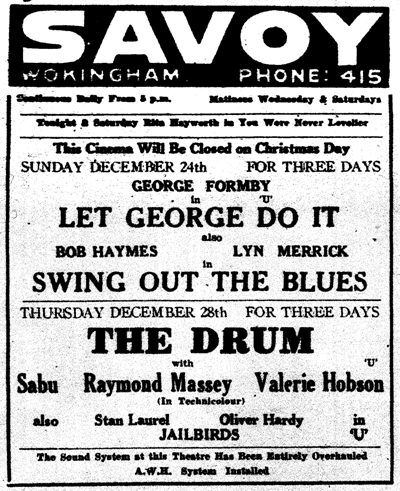
The Savoy advertises its latest showing. Post 1942

Affectionately referred to as ‘The Bug House’, The Palace was very popular with children who would queue up on Saturday afternoons to see their favourite Laurel and Hardy or cowboy film. Admission to the front rows was threepence; middle rows: sixpence and back rows one shilling and threepence. In the 1920’s one of the ladies in the box office, although almost blind, was able to identify the coins by touch and seldom made mistakes. One of the commissionaires was a Mr. Horace Blake veteran soldier who sported a waxed moustache with twirled ends. He would stand outside briskly walking up and down in front of the cinema controlling the customers.

During the days of silent films, music was used to increase the drama of the film scenes. At one time it was supplied by a violinist and pianist. Two of the earlier musicians were Mr. Otley, violinist, and Miss Adey, pianist, who was succeeded by Dorothy Blake. According to Edna Goatley, Miss Adey was a music teacher and, when she wasn’t giving Edna and Ken lessons, she would play some of the sequences from the films.

The walls of the auditorium were decorated with jungles scenes and monkeys, painted by Dick Giles, a local signwriter. During the years when one could reserve a seat, some cinema goers would ask for seats beside the monkey as they provided a better view of the screen.

To the right of the screen was a door which led to the toilets. It also led to an exit so it was quite easy for the children to go home for tea and return unseen for a second viewing without having to pay.

1937: The Union Cinemas Ritz Opens

The prestigious “Union Cinemas Ritz” opened in Easthampstead Road in May 1937 and, for a number of years it competed with the humble Savoy, also owned by Union Cinemas. With the introduction of television at the beginning of the 1950s, cinema audiences began to decline and the Savoy now owned by a Mr. Handford, was the first casualty. When the Savoy gave its final show, The Champion, on the evening of Saturday, January 6th 1951, the reasons, given by Mr. Handford were the high rate of entertainment tax and the impossibility of complying with the quota regulations that stated that 30% of the films shown had to be British. The building was later sold and became the premises of Courtney Reed Ltd.—house furnishers.

The Ritz cinema in Easthampstead Road was officially opened on Saturday the 29th of May 1937. It was one of the most modern cinemas of its time as the description in the following article from the Reading Mercury will illustrate.

The Ritz Cinema, Wokingham. Courtesy Dusaschenka.

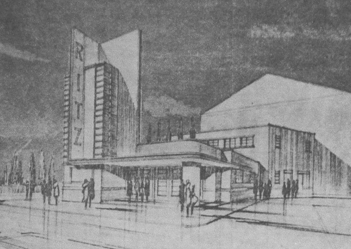
Saturday 29th May 1937– ‘Today (Saturday) the “Union Cinemas Ritz” will be opened to the public and the Mayor of Wokingham, Alderman F.J. Barrett J.P. will preside at the opening ceremony, which will take place at 2.30pm. Union Cinemas have set a unique standard in the furnishing and equipping of their theatres, incorporating the most modern ideas in design, combined with ideal comfort for patrons. The new “Union Cinemas Ritz,” Wokingham has been erected and equipped under the direction of Mr. J.H. Lundy of Union Cinemas Ritz, Wokingham the architect being Eric F. Tully L.R.L.B.A. the company’s staff architect. The new cinema is the most imposing building and occupies a commanding position a short distance down Easthampstead Road after turning out of Peach Street, the main thoroughfare of Wokingham. It affords a new car park with separate entrance and exit doorways and an exit into Denton Road for pedestrians. The main elevation to Easthampstead Road is carried out in red sand-faced bricks with stone dressings and is of light modern design. The entrance doors are featured on the corner facing towards the main street and are surmounted by a broad canopy, lighted on the underside by Neon tube lighting, whilst the opposite corner runs upwards in the form of an imposing tower and is in turn featured by tall projecting vanes to the front and side. These vanes serve the purpose of displaying the theatre name and are picked out in Neon lighting. The auditorium seats are all set radially thus affording a perfect vision of the screen from all positions and are served by gangways of generous proportions leading to exits at the front and rear. The interior scheme is in a light

‘The Ritz Cinema interior, Wokingham Courtesy Dusaschenka’

decorative trend and much use has been made of Spray texture on which the varying tones of colour give a very pleasing effect, whilst leading the vision to the main decorative feature on the anti-proscenium walls. Excellent effect has been given by the two ornate grills set on either side of a large vertical cove, draped with silk and satin materials and artistically lighted. The main auditorium lighting is by means of chandeliers of exceptional beauty and decorative dome lighting far in advance of the usual type of lighting schemes usually associated with the modern cinema. Altogether, the new “Union Cinemas Ritz,” Wokingham regarded in detail or as a homogeneous whole must take its place as an important, as well as an imposing structure in the architecture of modern entertainment. In the projection department many thousands of pounds have been spent on the finest equipment obtainable. The famous B.T.H. Sound Reproducing apparatus has been installed together with the latest high intensity arcs and powerful modern projectors. Electricity is called upon to serve patrons from the moment it delivers tickets at the paybox. It lights warms and ventilates the building; works the clocks; operates the curtains; projects the films; reproduces the sound—and a hundred and one other details. The wonderful air conditioning plant which has been installed is another of the most important features in the “Union Cinema Ritz”. It literally manufactures weather conditions, for, by its means, the air is washed as it enters the building and every patron is served with a specific quantity of purified air, warmed or cooled to suit varying external conditions. When it is hot outside the building the patrons will find it beautifully cool inside and on the other hand when it is freezing outside the auditorium will be comfortable, warm and cosy.

The Ritz. Illustration courtesy of Reading Mercury

It is gratifying to know that the new “Union Cinemas Ritz” has been built by local labour and local materials have been used as far as ever possible. The finishing touches are now being put to the new Union Cinemas Ritz, Wokingham, which will be opened to the public today (Saturday), at 2.30 pm and the programme that has been arranged for the opening ceremony and for the next week includes “Girls’ Dormitory,” starring Simone Simon. This film was especially selected to introduce Simone Simon to the screen, and she is surrounded by an impressive cast, which includes Herbert Marshall and Ruth Chatterton. “Girls Dormitory” is supported by “Three Married Men,” a sparkling, clever and true-to-life domestic comedy. Monday brings for three days, “This’ll Make You Whistle”. This gay musical film has proved Jack Buchanan’s greatest laughter maker.

The Ritz was proclaimed to be one of the finest in the south of England and the public was amazed and delighted to see the floor to ceiling mirrors that covered the walls of the foyer. There was also deep-pile carpeting, the seats were luxurious and dimming light was new. In the heat of a Saturday afternoon there was one place that was refreshingly cool—the Ritz cinema, Wokingham. The contrast between the temperature in the open and the Ritz left the impression that here was a cinema that was the acme in up-to-date comfort’.

The Ritz starts to crack.

Not long after the opening, however, the mirrors in the foyer began to crack. When buildings were being demolished to make room for the new cinema, older residents had warned the company about the suitability of the site. The problem was that Mr. William Denton had operated a chair manufacturing factory nearby and, over the years, sawdust had accumulated in the ground. The warnings were ignored and the sawdust, together with the natural composition of the soil, had resulted in instability. The mirrors were replaced with a more suitable wall covering.

Overview: A century of cinema-going

Going to the pictures in Britain in the early part of the 20th century was a very popular form of entertainment and by 1938, there were nearly 5,000 cinemas throughout the country. Going to the cinema or ‘the pictures’ was more than a night out. Courting couples and families often went to their local cinema twice a week to see their favourite stars and their local cinema was a ‘home from home’. Most cinemagoers had their favourite seats and, after buying tickets for the stalls or circle, they would queue up at the shop in the foyer for a bag of their favourite sweets or a packet of cigarettes. The frequent rustle of sweet wrappers and the haze of smoke during the performance were all a part of the evening out.

In the early years films, or ‘movies’, were silent and monochrome, or black and white. The ‘talkies’ were swiftly introduced in the late 1920s which brought about a significant increase in cinema audiences and this is generally accepted as being the start of the Golden Age of Hollywood. Meanwhile researches into animation and colour were in progress and, in 1937, cinema audiences were experiencing the wonder of Walt Disney’s first full-length film, Snow White and the Seven Dwarves. A year later came the excitement and glamour of The Adventures of Robin Hood starring the legendary Erroll Flynn.

Most cinemas gave continuous ‘double feature’ performances. For many it was their first introduction to luxury both in the cinema and on the silver screen itself. The former was lavishly decorated with curtains, mirrors, lighting and photographs of the stars while the latter revealed the envious lives of the upper classes either at home or in glamorous Hollywood where the sun shone continuously on fast cars, swimming pools or cowboys.

The doors usually opened early afternoon and the performance would commence with general advertisements followed by advertisements of films scheduled to be shown during the following week. These were known as ‘coming attractions’, or ‘trailers’. Then would come an interval during which members of the staff would enter the auditorium sell refreshments, mainly ice cream and fruit juice, which, for many years, stayed at sixpence or two and a half new pence. A Pathé film with the latest news would then be shown as there was no television in those days and, with luck, this was followed by a Disney cartoon. The ‘B film’ or low-budget film, usually a western, would come next and, after another interval, the audience would settle down to watch the ‘A’ film’ which was a more expensive production. Programmes were changed every three days (see advertisement opposite).

There was usually a full house and people came and went during the performance. If the film was a very popular one, queues would form and people would be allowed in when seats became available.

Advertising of future performances in the local newspaper was more detailed. Instead of merely providing the names of the films and actors, there was usually a resume of the films to be shown. The Reading Mercury, June 19th 1937, gives us an example:

‘Next week, until Wednesday, “Theodora Goes Wild” is being shown, featuring Irene Dunn and Melvyn Douglas. The ingenious plot concerns the adventures of Theodora Lynn (Irene Dunn), a small-town girl, who has written a highly successful novel. In order to keep the secret from her two aunts and her gossiping neighbours, she has written the book under an assumed name. She meets the artist who illustrated her book and he advises her to rebel against the narrow-mindedness of her neighbourhood, descending upon the vicinity himself to force her to bring about the emancipation. With this accomplished she proceeds to pay back in kind. It is at this stage that Theodora really goes wild’.

During the early years, admission to the Wokingham Ritz in the afternoon was sixpence in the stalls and one shilling and sixpence in the balcony.

Chums’ Club. About three weeks after the Ritz opened the following announcement appeared in the Reading Mercury of June 19th 1937:

‘Chums Club’. ‘September 11th 1939 ‘Courtesy Wokingham Times’

‘Last Saturday, close on 500 happy children were enrolled as members of the Union Cinemas Ritz, “Chums Club”. A glorious time was spent by the youngsters, a special programme being provided for them which included comedies, cartoons and cowboy films. The Union Cinemas Chums’ Club meets every Saturday morning at 10 am and membership and badges are free. The president of the club is Shirley Temple. Every week the youngsters will enjoy community singing, and prizes will be awarded for various competitions amongst them’.

Minors’ Monitors would read out newsletters, from the A.B.C.’s (Associated British Cinemas) head office, from the stage. Seat Monitors were in charge of a block of seats and their duty was to ensure that the other children behaved. The manager of the Wokingham Ritz took monitors to the Gorrick Woods from time to time for picnics and arranged visits to the projection room. Talent shows were held onstage from time to time and every year the Ritz was the venue for a series of events that culminated in the crowning of the Carnival Queen.

Union Cinemas were taken over by Associated British Cinemas (A.B.C.) in 1937 and they operated the Wokingham Ritz until it was sold to Star Cinemas in June 1969.

World War Two: Wokingham Ritz

Two years after the Ritz opened in 1937 war was declared and cinemas nationwide were closed. A notice displayed outside the Ritz cinema declared, CLOSED—by order of his majesty King Hitler and his Lunatics. The closure didn’t last long because by September 11th 1939, Maureen O’Hara appeared in My Irish Molly. At the end of hostilities the following statement was read out at the beginning of all performances for a week:

‘We, the Directors and Staff of Associated British Cinemas offer our sincere congratulations to General Eisenhower, Field Marshall Montgomery and all allied Naval, Military and Air Force Commanders on their brilliant victory. From our hearts we thank the members of the forces who did the job so gallantly. We further extend our grateful thanks to the men and women of Great Britain who so courageously withstood the blitzes and who worked in the workshops, the factories, the mines and on the land to make this victory possible’.

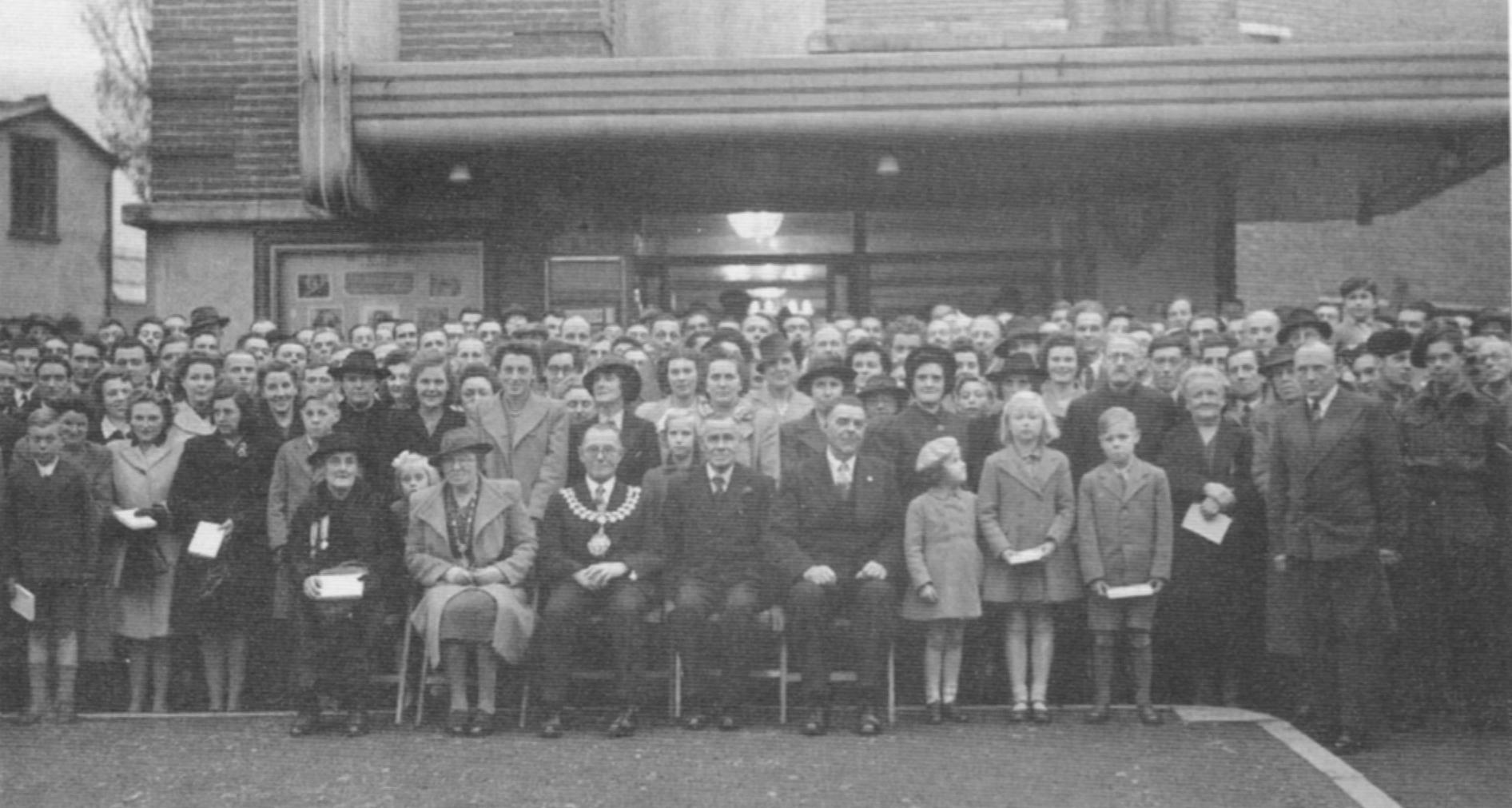
In addition to showing films, the Ritz was the scene of memorable events including ceremonies by the Mayor. He presented leather wallets of brown pigskin embossed with the crest of the borough and the recipient’s initials, to those ex-service men and women who were fortunate enough to survive the Second World War. A second presentation took place on Sunday October 27th 1946, when a further 228 wallets were presented. The presentations took place later than planned because earlier in the year the wallets, manufactured by the Home for Disabled Soldiers, were stolen.

Presentation of wallets outside the Ritz cinema. (click on photo to increase size). Courtesy of Grahame Smith

The Wokingham Times & Weekly News reported—

‘An impressive and poignant moment was when the entire audience rose to its feet during the playing of two verses of Abide With Me and remained standing while the relatives of those who did not return and who had intimated their desire to be present received the posthumous presentation of the inscribed wallets from the Mayor. By this natural and thoughtful gesture the thoughts of everyone in that packed building went out to those proud parents and wives in their tragic loss. Alderman Perkins who called out the names of the recipients pointed out that among them were several high-ranking officers and also a number of men who had been decorated—but this occasion was such that it was more fitting if the men be called by their Christian and surnames—omitting rank and distinctions. To judge from the audience’s reaction this decision was a popular one’.

Post War Ritz

More recently all public places of entertainment were closed on Good Friday. In Wokingham congregations from local churches and their choirs went to the cinema for a joint service.

As with all cinemas the Ritz employed a commissionaire, one of whom was Mr. Blake, who ensured that the waiting crowds didn’t misbehave. In his smart uniform, waxed moustache and ramrod-straight back he was a magnificent figure.

The Ritz then passed to Jora Leisure Ltd. an independent operator, on November 1st 1977 who converted the main auditorium into a bingo hall and used 180 cinema seats in the circle area on occasions when films were shown.

The Ritz went over to full time bingo from November 10th 1979 and, in 1981, an extension was built onto the front of the main building to house a small cinema. The former circle was partitioned off to create a second screen seating for 190. One of the screens closed in August 1990 because of falling audiences. Audiences continued to drop and the death knell was sounded when an announcement was made stating that The Point, a new 10-big screen complex at Skimped Hill in Bracknell, was due to open in April of the following year. Jora Leisure hoped for an upturn in audience numbers and kept the Ritz open over Christmas, but on Thursday, January 10th, the curtain came down for the last time. The film shown was entitled, Ghosts, and although many had protested against the closing of the dear old Ritz only fifty people turned up. The sad demise of the Ritz, which had once been a household word, had gone almost unnoticed. In keeping with other cinemas it was a victim of progress and the recession.

Bingo continues in the Ritz, operated by Gala, but the building has been stripped of all its original internal and externally features. Nothing of it’s former opulence has been preserved.

Approx Proprietors Name
1910-32 Wokingham Picture Palace Wokingham Picture Palace Ltd
1932-34 Electric Theatre D.W. & R. T. Hayward
1935-36 Savoy Electric Theatre Basingham Electric Theatres Ltd
1939 Savoy Theatre ditto
1941 Savoy Cinema Union Cinemas Ltd (part of A.B.C. Cinemas)
1950-51 Savoy Handford

Table shows Cinemas in Wokingham 1910 – 1951

Posted in All Posts, Jim Bell's Wokingham History | Tagged | Leave a comment

Philip Tice, a Wokingham WW2 Veteran aged 95.

Philip's letter to the Wokingham Tiimes February 2013

Philip’s letter to the Wokingham Tiimes February 2013 (click to view)

It’s fascinating to see how a network of contacts can pool information together and come up with some global connections. Wokingham Remembers has published hundreds of family trees on its website, as well as the genealogy site, www.ancestry.co.uk . The result of this has been a number of families contacting each other after going their separate ways prior to the Second World War; there have even been two separate incidents of families from Australia and the UK meeting up following a look at this website.  Along the way, we have met some talented researchers who can go the extra mile and find pieces of information which would have been lost forever. This week we received information from Alan Clark of Binfield who sent us a complete biography of two soldiers who we just couldn’t trace and another friend, Andrew Radgick has provided the same on more than one occasion. Then there is Peter Shilham who is an expert on all things Emmbrook and Jim Bell, who continues to unfold the secrets of Wokingham’s past and passes them onto us for publication. John Chapman has also provided a huge digest of information on the Wokingham men who served in the Royal Berkshire Regiment. So here is another tale of connectivity.

Ken Manifould. Philip Tice tells us how proud Ken was  of his moustache.

Ken Manifould. Philip Tice tells us how proud Ken was of his moustache.

Grahame Smith lives in Devon and wrote to us about his uncle Ken Manifould, a WW2 pilot who was killed when his Spitfire was shot down in 1941. He and his brother Howard, who has lived in Texas for 30 years compiled a huge family tree and very generously sent us a complete biography of their Uncle Ken’s war time activities. This week a Philip Tice wrote to the Wokingham Times asking about any information on Ken as they were friends in Wokingham prior to the war. Word got around and Grahame wrote to me about the letter from Philip. There is already quite a lot of serendipity in all this and the final piece is that Philip lives in Eastbourne; about a five minute drive from my home ! Notepad in hand, wild horses were not going to stop me from calling in to see him and I was greeted by a rather stunned 95 year old gentleman as I passed on Grahame and Howard’s research into their Uncle Ken.  Although Ken Manifould was an RAF pilot, Philip was unable to join him due to colour blindness and was enlisted into the army as a result. Philip saw service in many of the theatres known to military historians, including Africa, Iraq, Italy, France and Germany. I hope to have the opportunity to talk to this venerable gentleman, originally from the Wokingham side of the Reading Road and will write up the wealth of information he has at his disposal.

Written by Mike

Posted in All Posts, Articles on World War 2, Aspects of War, Story of Wokingham | Tagged , | Leave a comment

Wokingham Families: The Purseys, Brants, Rances and Alexanders

Wokingham Families and the Great War.

Recalling the 1914-18 war often involves descriptions of military strategy and the bewildering numbers who were killed or maimed on both sides.  What is often lacking in the tomes of history is the impact of the war from the perspective of the home shores.  The research into Wokingham’s memorial has shown us the numbers of losses each street suffered during the war.  If you look at the bottom on this page there is a map which shows these losses;  often eight or nine deaths in a single street. However, there is another perspective and that is the impact on the families within the community. Today’s Wokingham only shows glimpses of its village history and it is difficult to grasp how close a community it was and it is even harder to envisage what a ‘close community’ actually means.  What is also surprising is the community which existed for hundreds of years (as we shall see) has changed beyond recognition only in recent decades.  At the time of First World War, Wokingham was a small area of fewer than 7,000 people (1911 Census) as compared to the 35,000+ of today.  The tight knit nature of small towns such as Wokingham felt their losses not just on an individual basis, but as a community. Names such as Brant, Rance, Pursey and Collyer have been in the town for hundreds of years and a network of marriages during this period meant the losses laid heavily on the townspeople because the community was in effect, a large extended family. One example of this family network in Wokingham is the connection between the Purseys and Alexanders and when we start to look into this family, we very quickly find the relationships go much wider and deeper.  To help us understand these connections, we spoke to Mrs Christine Parnwell (nee Pursey) who is interested in her family history.  Christine gives us a little background to the early connections:

The Purseys were members of the old church at Barkham

“I and other family members have traced the Pursey family to the seventeenth century, where John Pursey married Ann Walden on 14th January 1748.  The Pursey family were associated with the village of Barkham for many years.  Many of whom (if not all of them) worked as agricultural workers living in tied cottages which went with their work”.

We can see by the photo on this page, a report of a proud Mr and Mrs T Alexander watching their sons go to war.  Mrs Mary Alexander was in fact Mrs Mary Pursey before losing her husband Charles and later marrying Thomas Alexander in 1909.  Mary and Thomas were later to witness the death of four of their sons, Henry and Thomas Pursey and William and George Alexander.  Charles Pursey senior was Christine’s Great Grand Uncle. Christine also has connections with the Rance family, whose name is mentioned on the Wokingham Memorial; Oliver and William Rance having lost their lives.  Christine tells us:

“My maternal grandparents had the surname of Rance and lived in the Plough Pub,

Christine’s mother, Matilda Sumner (toddler in front) and siblings 1922

London Road, Wokingham. The first listing I can find of Thomas and his first wife Ann is dated 1854. Thomas and Ann ran the pub for over a decade, then Thomas was widowed, he married his second wife Martha and ran the pub for at least another two decades. It is said Rances Lane may have been named after the family. I have found a Thomas Rance age 13 listed as a border at the Wargrave Union Workhouse, if this was my great great grandfather he did very well indeed as by the age 25 he was married to Ann and running the beer house (as it was called then) which is certainly an achievement coming from a very poor start in life. The pub then had 5 acres of land which Thomas and family worked on as agricultural workers, as well as running the pub and coping with a very large family. One of his daughters Florence was my grandmother, my Mum’s Mum. William Thomas Rance (on the Wokingham Town Hall Memorial) is I’m sure a relation, although as of yet I haven’t found the connection to the Plough Pub family”.  

Harold Rance sitting to the right of the trophy.

“I remember in the sixties having relations of Rance in Easthampstead road, no doubt descendants of ours. I have a football photograph of my Mum’s half brother Harold Rance (right of the trophy).  At the age of 14 Harold joined the Army (WW2) and rose to be a Major spending a lot of time in Nicosia. We have the date of 1933/4 on the football, but as yet not found any other information”.

Just to add to connections within this old Wokingham family, Christine’s mother’s maiden name was Sumner and we know of an Arthur Sumner, who was born in Wokingham, a Grenadier Guard and was killed in the First War on November 1st 1914.  The Sumner family came from Bramshill.

“There is a tombstone just inside the gate at Eversley churchyard of Ernest Sumner age 19 who had died in 1915, a gunner with the Royal Field Artillery.  I found later Ernest was my grandfathers’ (Alfred Sumner) youngest brother.  A few years earlier on the 1901 census Ernest was a shepherd’s boy age 14, just so sad to think of him and all the other young men dying so young”.

Christine provides more information of the intertwined nature of the Wokingham families:

Christine’s Grandmother, Rosina Pursey (nee Jewell). This photo taken outside Robinswood the lodge at California Crossroads where the Pursey family lived

“Our family is complicated as my Dad’s widowed Mum (Rosina Pursey) married my Mum’s widowed Dad (Alfred Sumner) bringing both families together merging 15 children, Mum being the youngest at 14, Dad was 19.  It was the first time my parents had met and in later years (1947) they married, although step brother and sister they were not blood related.  This meant I only had one set of grandparents who I don’t really remember, as Mum’s Dad (Alf) died in 1952 when I was 3 and Dad’s Mum (Rosina) died in 1956 when I was only 7.  So sadly my brother and I grew up without any grandparents. I don’t have many photos of the grandparents as they were all very poor and probably a camera was a luxury.  I have never seen any photos at all of Dad’s Dad (Edwin Pursey), he died in 1933 age 59.

Alfred Sumner, Christine’s Grandfather.

Henry and William (named in the Wokingham Town Hall memorial) were Charles Pursey’s sons and Edwin my grandfather was one of Richard’s sons.  Charles and Richard were brothers so that made William and Henry Edwin’s cousins. My grandmother, Rosina married into the Pursey family, her maiden name was Jewell who came from Hurst.  I’m surprised there are no mentioned of any Jewells on the memorial as they were another large family who must have had young men in the WW1”.

In this short biography, we start to feel the sense of loss which were felt along the wires which bonded many families together in Wokingham.  What is also fascinating is how if there was a premature loss in the family of a husband or a wife, that they would, by necessity (as no benefit system then) as much as love, remarry and combine two already large families into an even larger unit. The rural communities required all members of the family to work in order to provide sustenance and ultimately, survival.

Christine then finishes with a passage which will describe many of our experiences of childhood:

“I was born in 1949 at Barkham which is three miles out of Wokingham.  As a child on many occasions I went with my Mum shopping in Wokingham I remember some of the old shops Ken Goatley mentions in his history of Wokingham.  Although we weren’t well off my brother and I had a lovely childhood, we played outside in all weathers and were free to roam, we had healthy food often grown in the garden and fresh eggs from our own chickens. Those were the days, what I call a lovely natural healthy childhood”.

Posted in All Posts, Aspects of War, Story of Wokingham | Tagged , | 3 Comments

Cecil Culver. Introduction by Jim Bell

Cecil Culver 1910 – 2009

Today we start a magnificent series of recollections by Cecil Culver, one of the great cornerstones of the Wokingham community. Sadly, Cecil died in 2009 aged 99, but we are fortunate in being able to receive  his memories of Wokingham in the twentieth century. Jim Bell provides us with the following introduction:

“Cecil and I became acquainted a few years ago, just after I retired, when I agreed to take his laundry, together with that of his friend Edna Goatley, to the local laundrette every second Thursday morning. This turned out to be one of the most profitable decisions I have ever made for it gave me access to a supply of valuable local historical information. When Cecil discovered that I was writing about a subject with which he was familiar he would ask me to visit him for a chat. His idea of a chat was him talking non stop while I frantically scribbled on a notepad. The hours would fly. His eloquence, phenomenal memory and appearance—the inevitable bow tie, green jacket, slacks with knife-edge crease and patent leather shoes—transported me into a Wokingham world of bygone days in which the pace was a shade slower, everyone knew one another and, “You had to mind your ps and qs”, as he would say.

Ken Goatley writer and historian, interviewed Cecil Culver on Wokingham in the 20th Century

The last time I saw Cecil was at about half past nine on the morning of Thursday, 12th November 2009, the day he left this mortal coil. He was his usual self—as bright as a cricket—to use one of his expressions. We discussed the weather, and as usual, exchanged a couple of jokes. As I walked to my car he called, “I have to go shopping but I’ll be back by twelve!” Soon after he died Edna told me that her husband Ken, local historian, had interviewed Cecil three times. Two had been recorded on audio tape and the third on video. After listening to them I decided that the information about Cecil and early 20th century Wokingham should be preserved and made available for posterity”.

Jim Bell

Posted in All Posts, Cecil Culver's Wokingham, Jim Bell's Wokingham History, Story of Wokingham | Leave a comment

Cecil Culver’s Wokingham. One: The early years

It was in Isiah Gadd’s warehouse that Cecil was to meet his future boss and mentor

Jim Bell continues with the magnificent series of recollections by Cecil Culver, one of the great cornerstones of Wokingham’s 20th century community. Cecil died in 2009 aged 99, but we are fortunate in being able to receive his memories of Wokingham during and after the Great War.

Cecil William Lewis Culver was born at home, 185 Broomwood Road, Battersea, on the 7th of June 1910. He always remembered this address because, as soon as he was able to speak, his father taught him to say his name and address in case he was lost. Cecil’s parents, William Culver (1869-1934) and Florence Amée Culver (1879-1965) had married in 1909.
Cecil and Florrie left Clapham just after William, who was serving as an officer in the army and who was rarely at home, was called back to his regiment in June 1914. Florrie realised that the First World War was going to last for some time and didn’t relish the prospect of living in London on her own with a small boy when her parents had a big house in Wokingham. She therefore made arrangements to move the family possessions to her father’s home at 22 Sturges Road, Wokingham.
The first time Cecil saw Ernie Reeves was when he and Florrie went to Gadd’s removal company office, in Broad street, to make arrangements for the transportation of their furniture. Little did the four-year old Cecil realise that the youth he saw in the shop, with his hair parted in the middle, would be his manager for many years.

Cecil Culver 1910 – 2009

Said Cecil—
“In those days removals were either carried out by rail or by horse and cart, so Ernie sent one of those standard pantechnicons up to London to pick up the furniture and bring it to Wokingham. All these furniture vans were built on the same lines. All the removers had the same. They were tunnel vans with two big wheels in the back, and small ones in the front, and a seat on the top for the driver. Ernie’s team left Wokingham and travelled as far as Hounslow, where they stayed with the horses, and the men got a bed for the night. On the second day they went into London, loaded up, came back to Hounslow for the night again. Third day it was from Hounslow to Wokingham, and on the morning of the fourth day, they unloaded. It took three and a half days. Steam-drawn wagons were never very satisfactory because first of all you had to carry coal with you. It was usually carried in sacks on the back of the van that was being drawn. It was mucky of course. You had to make sure you didn’t get it mixed in with the furniture. Then of course you had to pick up water on the way. And unless you knew the geography of the place to which you were going you could land up with a dry engine. Eversley Cross was where they’d pick up water at the bridge. Then they’d probably go on to Sherfield-on-Loddon and pick up more water that would take them into Basingstoke.

But that’s the way they did it. It didn’t last very long. Bishop’s had one. I saw the actual thing that had been rubbed up as a showpiece and Roger Bishop was driving it. You had to go in the direction of the water so you had no advantage really. They could employ them only on short hauls where they may pick up a bit of time otherwise it was horse-drawn.
There were no internal combustion engines fitted to lorries or anything like that during the First World War and whenever you have war there are always many things that are pushed forward and the internal combustion engine was one. Because Churchill, who was the warlord at the time, was much the same as he was in the Second World War—pushing—and he got engines developed that would power a lorry. They weren’t as big as the ones we have now but they were big enough to carry troops and ammunition to and from the front. Of course with further development he was able to use a tank.

The internal combustion engine came into its own during wartime and it was only after the war that a lot of these lorries were sold off cheaply by the government and that’s when you started to get vehicles on the road. But here in Wokingham you could count the cars that were owned on the fingers of one hand. There were no buses or anything like that—nothing in the way of lorries. London had buses but they were very small things. They had rubber tyres—nothing like buses you have now. They were much the same. Their tyres were more like bicycle tyres.”

William Culver (1847-1924), Cecil’s grandfather, was a master carpenter. Born in Merrow, near Guildford, his previous employers included Wixenford School (Ludgrove School area), where he was a cabinet-making instructor; John Walter III of Bearwood and the Rev. Joseph Stratton, master and chaplain, of the Lucas Hospital.
Soon after he came to Wokingham William married Jane (1847-1917), a daughter of the Lewis family, who were long-established Wokingham builders. William and Jane first moved into No. 22 Carey Road. They had three children: Horace (b. 1875); Lilian Emily (1877-1937) and Florence Amée (1879-1965).
A public-spirited man William put himself up for election as town councillor in November 1897 but was unsuccessful. He succeeded in the following year serving in the council until 1904. During this period he served on a number of committees including Bye Laws, School Attendance, Pleasure Grounds and Lighting.
William a carpenter, and Horace an architect, began to construct houses in the town. They built the next family residence, No. 22 Langborough Road, and seven others in Sturges Road, including No. 22, Corra Lorne and No. 24, Southwell. According to Roger Hoskings, who resides in a Culver house in Sturges Road, “The woodwork in the houses he built reflect William’s mastery of his woodworking.” William was closing down his business when Cecil and Florrie came to live with them. 41 Corra Lorne was to be the last address of Cecil and his brother Derek John Lewis (1917-2003) who eventually became the longest established residents in Sturges Road.

Wescott School opened in 1906, only four years before Cecil was born.

Cecil started his education at Wescott Road Primary School at the age of five. He was sent to Wescott because a grand aunt, a Miss Lewis, was teaching there. It became apparent that Cecil was very intelligent for he won a scholarship to continue his education at Ranelagh School in Bracknell. He studied at Ranelagh from 1921 to 1927 passing his examinations with excellent marks. He also developed a lifelong affection for his school and left with many happy memories.
Said Cecil—
“There were only just over a hundred of us at Ranelagh in those days. We were put through the hoop pretty well. The headmaster was a very keen character and the staff was good. I called on one of the staff in 1982. I was doing duty for Bishop’s in Liverpool and I found she was in an old persons’ home, only a stone’s throw from the office in Birkenhead, so I thought I’ll go round and see her.
When somebody said, “Will you see Mr Culver?” I heard her voice saying, ”Yes of course I will. Show him in. He’s one of my old boys!” She was 87, as bright as a cricket. The only problem was that she was a bit dodgy in getting around. She had a bit of rheumatism I think. She asked about everybody and didn’t forget the names of anyone. She wanted to know about everybody”.
Soon after leaving school, Cecil joined Ranelagh Old Boys’ Society as an active member, and approximately two years after the end of the Second World War, he and a group of fellow supporters formed the Friends of Ranelagh. Cecil was elected Chairman, a position he occupied for well over forty years. During the fifties, he and his Committee were instrumental in compiling and putting into operation a programme of building and modernisation. Later, in the mid seventies, they supported the then Headmaster, Mr Richard Allen, when the future of the School was in very considerable doubt because of the introduction of the comprehensive system. There is little doubt that the Friends contributed very considerably towards the successful school it is to this day. When Mr Allen wrote History of Ranelagh, published in the millennium year, he drew upon the phenomenal memory which Cecil had for names, places and dates for the compilation of his work.

Cecil’s first job upon leaving school was as a clerk in a bank in Whitehall travelling there daily from Wokingham to Waterloo by steam train. Although the train stopped at almost every station, the journey took only five minutes longer than it does now by electric train. He didn’t care for the job, and after working there for six years, the depression came and staff were made redundant. Cecil left the company and found employment with an insurance firm in Reading.
In the mid-thirties Cecil met, and fell in love with, Edwina Marie Teresa (1913-1965), daughter of Edwin Moore, the owner of a four departmental shop in the Market Place, and who lived around the corner in Denton Road. One of the departments was a hairdressing salon run by Edwina, the centre of Cecil’s attractions.

Cecil’s wife Edwina worked in the family business prior to branching out on her own.

Edwina later went into business for herself eventually opening two salons at Nos. 13 and 23 the Market Place and one in Church Street, Crowthorne. The happy couple were married at All Saints Church on the 9th of June 1937 after which they moved into the flat above the salon at No. 13 Market Place where they resided for the next sixteen years.
Edwina sold the business in 1953 and she and Cecil moved to Corra Lorne that was still occupied by Cecil’s mother and Horace. Jane was severely arthritic and had difficulty climbing the stairs only coming down in the morning and going up to her bedroom in the evening. As her condition was worsening Cecil advised her and Horace to move downstairs. Using some money that had been left to him by an old friend Cecil turned the house into two separate apartments and he and Edwina moved into the upper one. This was very convenient for them being only a few yards from the centre of the town.


Posted in All Posts, Cecil Culver's Wokingham | 7 Comments

Cecil Culver’s Wokingham. Two: On the move

Down to Business: Reeves Removals. Jim Bell continues with the magnificent series of recollections by Cecil Culver, one of the great cornerstones of Wokingham’s 20th century community. Cecil died in 2009 aged 99, but we are fortunate in being able to receive his memories of Wokingham during and after the Great War.

For some time one of Cecil’s school friends Gordon Reeves, whose father Ernest was owner and manager of Reeves Depository and Removal Company, was very keen for Cecil to join the company. So two years after Cecil and Edwina married, Ernie Reeves visited Cecil to ask if he intended to sell insurance for the rest of his life. Cecil replied that he hoped not and accepted Ernie’s offer of employment as a trainee.

Ernest William Reeves (1890-1963) was an astute businessman. An employee of Heelas of Reading in his early twenties, he resigned and joined Isaiah Gadd’s removal business in  Wokingham, as manager. In addition to the removal business, Gadd had an antique shop and was a coal merchant. His depository was located at the junction of Finchampstead and Carey Roads.
After Gadd’s death in 1913, Reeves in partnership with a business friend, took over the  removal business. He then purchased the cottages in Carey Road, had them pulled down, and extended the warehouse. He also turned the auction room on the ground floor of the building into storage for pianos.

In 1935 he built another warehouse, which his competitors named Reeves Folly, because they thought that he would never fill it. Ernie estimated that he would fill it in two years. He filled it in six months. According to Cecil, “The warehouse was so full it was bulging at the seams. Furniture was stacked in the passageways waiting for a hole to put it away.”

There were stories, however, that Ernie had deliberately moved furniture from other places of storage in the town to the warehouse so that it was always full. The other places included the old Gospel Hall; premises on The Terrace, which had accommodated the Girls Friendly Society, and some shedding at the Wokingham Town House.

Ernie Reeves wanted somebody who would try and sell his business for him and Cecil seemed to be the ideal man for the job. He started work in the office for a few weeks then he was transferred to the warehouse where he learned how to make inventories. After another period in the office he was sent on to the road to travel with one of the team. By this time he could describe what Reeves could offer to prospective customers. Cecil sought out clients and when he found someone who was moving house, he would approach them, identify himself, and ask if they would like a free estimate. They very often accepted the offer and he would give them an estimate which started the correspondence and which, quite often, resulted in Reeves being awarded the contract.

Classic advertising pushing home the company’s strengths.

Just before the start of the Second World War, in July of 1939, Gordon Reeves was called up to join the army leaving Cecil and Ernie to manage the company. Cecil was not required to enlist in the forces because of the type of work he was doing. Towards the end of the war he was medically examined and it was found that he had problems with vision so again he
was not called up. At that time Ernie was Mayor of Wokingham and when hostilities commenced, in addition to his mayoral duties, he was called upon to chair wartime committees and other events. Said Cecil— “I was thrown in at the deep end. Ernie had such a commitment that he would leave the office at about half past ten in the morning and we saw no more of him until nine o’clock when he turned up the next morning. Ernie would say, “There’s a lot of calls here so you had better sort them out. See what you can do today with them.” Most of them were in London. I would sort them out in districts and carry on. Ernie would leave after half an hour’s briefing and I would get on with the estimating. To increase my knowledge I joined the Removals Institute that was coaching people in the removal industry. Ernie had a number of books which also helped.”

Because of the danger of bombing there was a great demand for storage from people wanting to leave the cities, mainly London. In a short time the depositories were filled and Reeves was forced to use open shedding with only a roof and tarpaulins to keep the rain out. Surprisingly when the tarpaulins were removed, two or three years later, the furniture was still in good condition. One of Cecil’s tasks was to tour surrounding areas of Wokingham to find farmers willing to rent out their cowsheds to be used as warehouses.
If the farmers agreed they would clear the cowsheds and whitewash the walls. Many of them were only too pleased to earn money in return for very little work on their part.

Tragedy. Gordon dies from Blackwater Fever. A terrible loss for his father and best friend Cecil.

Sadly, in 1943, Gordon died from Blackwater Fever (Malaria) while serving with the R.A.S.C. in West Africa. As he was the Reeves’s only child, it is possible that from then on, Cecil almost became their surrogate son.

At the end of hostilities Cecil persuaded Ernie to make a few changes that he had learned from the institute. He then studied and sat the exams which he passed, winning a silver medal for being top man in the country for estimating. In the following year he passed the Manager’s Examination. From then on he gradually progressed up the company ladder. Over the years Reeves prospered and expanded, and when Ernie retired, it had become one of the biggest and best in the south of England. The company was later managed by a board of directors, and was eventually acquired by Bishop’s Move.

Cecil Culver 1910 – 2009

When, in 1975, it was time for Cecil to retire, he pointed out to Bishop’s that they needed somebody to look after their branches when managers went on holiday. Usually the manager would select one of his family to take over the branch. Unfortunately the person chosen usually didn’t like the work and did very little. So when the unfortunate manager returned he would curse his replacement because all the work had piled up in his absence. Bishops accepted the offer and Cecil did this for eight years. Unfortunately Edwina underwent a major operation after which Cecil realised that he would have to care for her indefinitely. He retired from the company for good.

Posted in All Posts, Cecil Culver's Wokingham, Jim Bell's Wokingham History, Story of Wokingham | Leave a comment

Cecil Culver’s Wokingham. Three: Fun, Friendship, Fraternity.

Jim Bell’s final instalment of the life of Cecil Culver tells us about how the Wokingham community organised its leisure and the important friendships which arose.

The Cheerio Concert Party

Despite onerous responsibilities at work Cecil found time to pursue various pastimes, one of which was participating in an entertainment group known as the Cheerio Concert Party. He had joined the group because his friend, David Goddard, who lived nearby in the Co-op cottages near the Salvation Army Hall, was a also member. David was the leading member of the concert party. Cecil felt that he had great talent and if he had had a better opportunity he would have gone a long way. Although David became Mayor of Wokingham, he was employed all of his life as a clerk on the railway.

Endowed with a flair for organisation, David organised the Wokingham Carnivals for several very successful years. He also ran a boys’ club called the The Wokingham Junior Social Club. He was a very gentle and sincere man and also ran The Wokingham Junior Old Boys’ Club and a football club. Even when the boys had grown up and moved away he maintained contact with them by correspondence David was in charge of the group and arranged transport and finance. He also sang and recited monologues. The pianist was Percy Fuller who travelled for a wines and spirits company in Reading. Wiffles Westlake, whom everybody knew, was the comedian. Bert Dicker, a delivery man for the Co-op bakery, was the singer. Curly Thatcher, who played football later in life, was the yokel farmer’s boy. Cecil was the fop and a stooge for Wiffles. The group performed two or three nights a week in the season and they were transported by Tom Herring in his taxi. Tom also carried the bags. The members of the group were always paid at the end of the season.

The Later Years
The following extracts are taken from the excellent eulogy, delivered by Rotarian David Garrod, at Cecil’s funeral service at Corpus Christi Church, Wokingham on the 30th of November 2009.
Mention must be made of Cecil’s sartorial elegance. Always dapper in appearance, he would not leave the house until, in his own words, “he was suitably accoutred”. He was, I believe, fairly extravagant for one of his early suits was made of the best barathea cloth. We remember him for his many and varied bow ties and for his colourful and embroidered waistcoats which he wore with his dinner jacket, and also for his all-enveloping cloak with scarlet lining, a wide brimmed black hat, and completing the ensemble, a silver topped cane.
He had many interests in his life, and as a youth, he was an accomplished and popular ballroom dancer. Contemporary photographs at this time show a slim, upright, good-looking young man. We know that he was well educated, well-spoken, intelligent and had a ready wit. What a package for the ladies!

He was a member of the Wokingham Theatre Company in the days when they were based in Norrey’s Avenue, though I do not know what productions he participated in. He was a popular M.C. at their social functions and dances.
He was a Vice-President of the Wokingham Horticultural Society, and later became a life member. I know that this position was rather a joke, for he was the first to admit that he knew next to nothing about horticulture. This position was perhaps an outward sign of his increasing stature in local society. They required a figurehead to officiate and present prizes at their annual shows. Soon after joining Reeves, he became a member of the Reading branch of the National Association of Warehousemen and Removers, served on the Committee for many years, and was President for a year. This association was very important for the Company and him personally, for it enabled him to develop a wide understanding of the business and of establishing contacts all over the country and thus he gained a wide circle of friends.

And so I come to his life in Rotary lasting 49 years. Ernest Reeves, his old Boss, was a founder member of the Club in 1951. He obviously decided that his efficient Manager would make an excellent addition and he was inducted in 1960. In the interests of brevity it is impossible to chronicle all his activities. At one time or another he held almost every post within the Club—Club Secretary, Bulletin Editor, Youth Exchange officer, Chairman of sub committees, and in 1968-9 he was Club President. Incidentally his wife, Edwina, was President of the Inner Wheel Club in the same year, the first such double in the Club’s history.

He was a passionate believer in the Principles of Rotary, of service above self, and in the promotion of International understanding and goodwill. Most of all, he perhaps enjoyed his contribution to the Foundation movement, where he both found possible candidates for the Youth Exchange programme, and attended rallies all over the district in support of students from overseas who had won a Rotary scholarship to study at Reading or Oxford Universities.

Within the Club, he was renowned for his knowledge of the rulebook, and on occasion did not hesitate to let us know! He was a sort of elderly troubleshooter. Many a soporific business meeting was enlivened by his comments and interjections, and he was almost always right. He also stimulated us to think again about a particular problem perhaps in a new light. His services to the Rotary Club were recognized, when in 1997, the members presented him with the award of a Paul Harris Fellowship. This singular honour was amply justified. He was the first person to receive this prize in the history of the Club.

Unhappily, in 1983, his wife Edwina underwent a major operation from which she never fully recovered. Following this, very gradually, she began to have increasing bouts of depression and also agoraphobia. She, who had been vivacious, good looking, a well dressed member of society, who loved a party, became withdrawn, self-neglectful, and a virtual recluse. Throughout the long period of her decline Cecil faithfully looked after her. He became the housewife doing the cleaning, washing and shopping without complaint. When she died in 1997 they had been married for 60 years and 12 days.

In the ensuing time he was increasingly afflicted by his failing eyesight. He had to give up driving and dispose of his car. He however remained fiercely independent continuing to look after himself and living alone at No 22 Sturges Road. He had a number of loyal friends who helped, by ferrying him about to meetings and functions. They also looked after his correspondence and his financial affairs. Others looked in on him for a chat, and when he walked through the town, he stopped many times to talk with friends.

He was very lucky in his death which was quick, clean and with the minimum of fuss. In his passing, Wokingham has not only lost one of its oldest citizens, aged 99, but also one of the most respected. I consider it highly unlikely that we will ever again have the privilege of knowing such a universally popular person, or as one of his many lady friends put it to me a day or two ago, such a lovely man.


Posted in All Posts, Cecil Culver's Wokingham, Jim Bell's Wokingham History, Story of Wokingham | Leave a comment