The Somme Tunnels on BBC 4. Monday 19th May 9pm

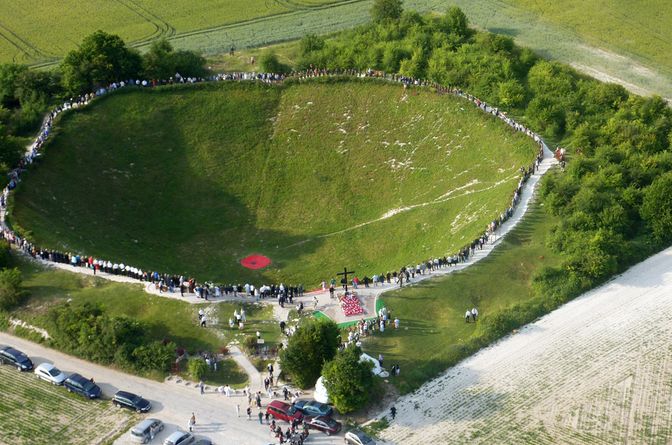
Lochnagar Crater, one of the huge mines which were exploded by the British during the Somme, 1916.

Lochnagar Crater, one of the huge mines which were exploded by the British during the Somme, 1916.

One of the Western Front’s great journeys is a visit to the Lochnagar Crater in La Boisselle, a huge hole which is now the subject of a wider investigation called the La Boisselle Project. It is also a central site of the Battle of the Somme, which was responsible for the greatest single loss of life of our Wokingham men. The story of the tunnelling and mining which took place during the war, has captured our imagination and now appears regularly on TV. Tomorrow night the story receives another airing and it will be well worth watching on BBC 4 at 9pm – Monday 19th May. There are a couple of links above and the following superb video can also be seen (with others) on www.laboisselleproject.com There is another aspect to this project and that is the enthusiasm which exudes from the very approachable Banning brothers, Jeremy and Mark. If you click on the Lochnagar Crater link, you will also find out about another engaging character, Richard Dunning who purchased the crater in the seventies in order to protect its memory and significance to British culture.

Finally, last year we wrote a piece on Sebastian Faulkes’ ‘Birdsong’ and including some stories from the men who experienced this haunting aspect of the war.

Posted in All Posts, Aspects of War | Leave a comment

Home Deliveries

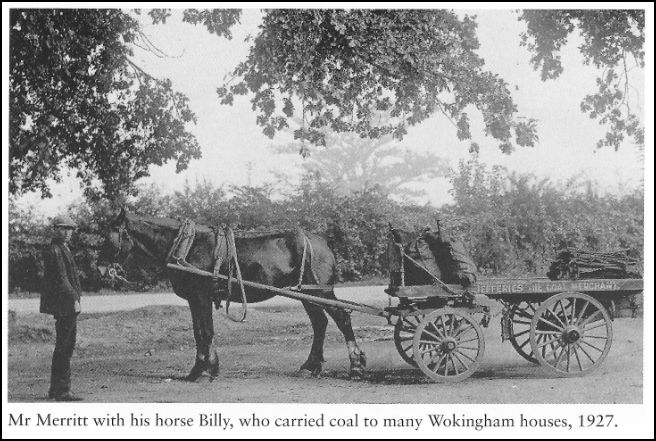
Coal deliveries 1927We continue the conversation between Ken Goatley and his old friend Cecil Culver.

Ken: “You were talking about the milkman taking his milk out of a churn. That rings a bell with me. When I was a kid living in Rose Street we had the Woodcray Manor milk, and a chap by the name of Doug Hamilton was our milkman, a young man who used to come along on his trades-bike. And I well remember he had the churn in the front of his bike and he would balance himself with one foot on the front step.

Mum would give him the jug and he would ladle out a pint, or whatever, into the jug. But the thing that always worried me, and fascinated me, was the fact that everlastingly, he had a dewdrop on the end of his nose. That used to worry me”.

Cecil: “The same thing was passing through my mind because I remember there was a chap at school, Len Pike. His sister Mary is still around here somewhere. I saw her a while ago.

Len, when he left school, became a milkroundsman. I remember he always used to come round to the backdoor, and my brother was about three years old at the time, and Len always had a word for him. And when it was real wet weather Len wore one of these trilby hat things. When he was bending down over the can to ladle out the milk, the rain ran off his hat into the can”.

Ken: “Talking about a trades-bike—you mentioned early on about errand boys at the shops doing deliveries about the town. Perhaps we ought to have a word about how they did these deliveries. They didn’t carry them around by hand obviously”.

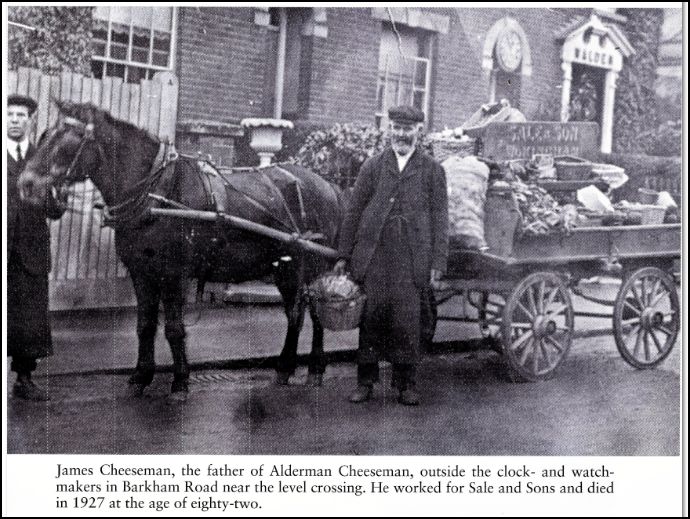
The Sale family were also Aldermen in the town

The Sale family were also Aldermen in the town

Cecil “No. They had a heavy trades-bike with a big pannier in the front usually. Parcels would be dumped in there. When a housewife went shopping, especially when she went to the grocer’s, she would have her shopping list”.

Ken: “That triggers another memory, with me, actually. You must remember old Rawlings in the Market Place—a grocery shop. His errand boy was Jack Rance who lived by the side of the Wesleyan Chapel in Rose Street. And I lived in what had been The Eagle public house on the other side of this church.

Jack was going away for a few days. Now Jack was quite a tall lad— two or three years older than me—and he said to Mr Rawlings, “Snowball will do it”. He always called me Snowball because I had a lot of white curly hair, “Snowball will do the round”.

I went to Rawlings and he gave me this big bike with a stack of goods on the front. I couldn’t ride it at all but I pushed it through Cockpit Path, up to Fairview Road, where I had to take it. I got round the corner and the whole lot fell over. I was panic-stricken. I didn’t know what to do with it. It was far, far too heavy for me to lift. I don’t know how I got out of it. I think I probably just walked away. Anyway that’s another story.

Now we did talk about the delivery by horse and cart and that really was everything. We spoke about the milk floats. But of course all deliveries in the town and vicinity were done by horse and cart for many years”.

Cecil: “Yes. Bread was delivered. I remember there was a bakery down the end of Rose Street. She was delivering loaves around Wokingham until quite late on”.

Ken: “Oh yes, up until 1960 more or less. Mrs Carter, Cyril Carter’s wife”.

Cecil: “A horse-drawn van with a place on the back”.

Ken: “There was the Co-operative Society. All their bread was delivered by horse and van—all the coal merchants, and of course, the other thing was the railway wagon with old Bob Hyde and Tom Philips. People today go round the Town Hall and see the horse trough with all its flowers in it We both know that it was removed from its original site. For very many years that was the means of the horse having some refreshment. I remember them queuing up to use it. Nowadays, of course, it’s pretty but not used”.

Note: The Rance family are mentioned in this conversation and a link provided to take you to a description of William’s Rance’s death. If you would like to see how the families were intertwined in local communities, read this

Note: Thanks to Bob Wyatt for his photos and descriptions.

Posted in All Posts, Cecil Culver's Wokingham, The Ken Goatley Interviews | Leave a comment

Schools

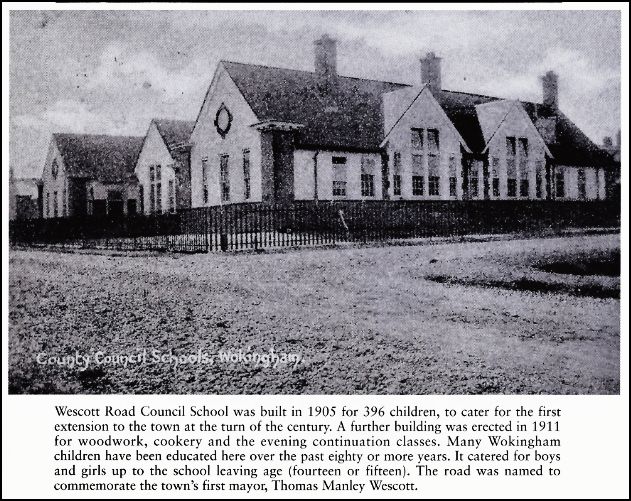
Wescott school 1905

Cecil and Ken discuss the schools which existed in the first half of the 20th Century.

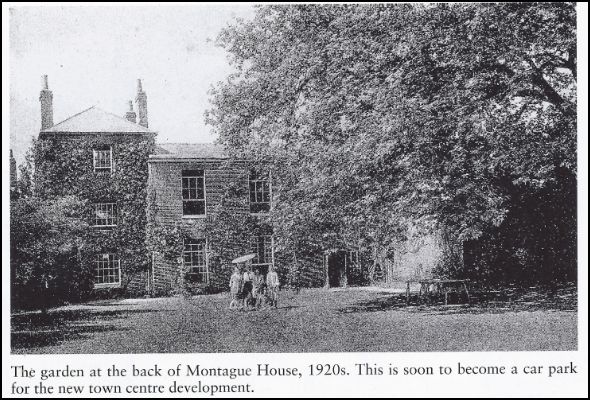
Cecil: “In 1914, when I came here, there were three state schools in Wokingham. There was the Palmer School which was possibly the most popular (now Palmer C. E. Junior School, Norreys Avenue). That has since disappeared. It has been pulled down and built over. There was the Wescott Road School (now Wescott School in Goodchild Road) which still exists and still functions. And there was the St. Paul’s School, which was situated just alongside the clock tower in Reading Road, at the confluence of Reading Road and Station Road (now St. Paul’s C. of E. Junior School in Oxford Road). Those were some of the state schools in Wokingham. But there was quite a number of fee-paying grammar schools around. There were two in Reading. There was the Collegiate School and Reading School. They were both fee-paying grammar schools for boys, and there was Ranelagh School at Bracknell, which was a fee-paying school for both boys and girls. It was co-educational. There was also a private school in Wokingham called Grosvenor School and that was run by a Miss Baker. Montague House 1920sAlthough its name was Grosvenor School it was more often known by the locals as Miss Baker’s School. It was situated in the house at the end of Broad Street that is now occupied by the doctors’ surgeries. And as it grew in size it was removed to the house in Broad Street—Montague House (now White House Preparatory School in Finchampstead Road). It was a very popular school for girls only. It was so popular that quite a few of the girls came from as far away as Ascot and Sunningdale. Those were the fee-paying schools.

The state schools—Palmer School and so on—were the places where most of the youngsters in Wokingham went. The youngsters who went to these state schools usually left at the age of fourteen—and most of them couldn’t wait for their fourteenth birthday when they were able to leave. When they left, the boys and girls went their ways”.

Posted in All Posts, Cecil Culver's Wokingham, The Ken Goatley Interviews | Leave a comment

An introduction to visiting the battlefields of the Great War.

family at Flat Iron Copse cemetery

family at Flat Iron Copse cemetery

Sarah starts this series of articles of her family’s experiences on visiting the battlefields of the  First World War. 

During the First World War the                 “Western Front” ran from the Channel coast to the Swiss/French border. For much of the war the Allied forces were fighting along this front. The name has become synonymous with the First World War. Looking at a map of the cemeteries of the war, the line of the Western Front is clearly marked by Commonwealth war grave cemeteries and memorials, showing the sad cost of war on that front.

How it all started

Around 20 years ago my family and I “discovered ” the battlefields of the Somme in Northern France and since then we have enjoyed many holidays there. We enjoy spending time understanding the battles that took place, walking the countryside to appreciate the ground so fiercely fought for and visiting the cemeteries and memorials and reflecting on the human cost of that war. Since then we have visited areas all along the Western Front and other theatres of the war including Gallipoli and Italy.

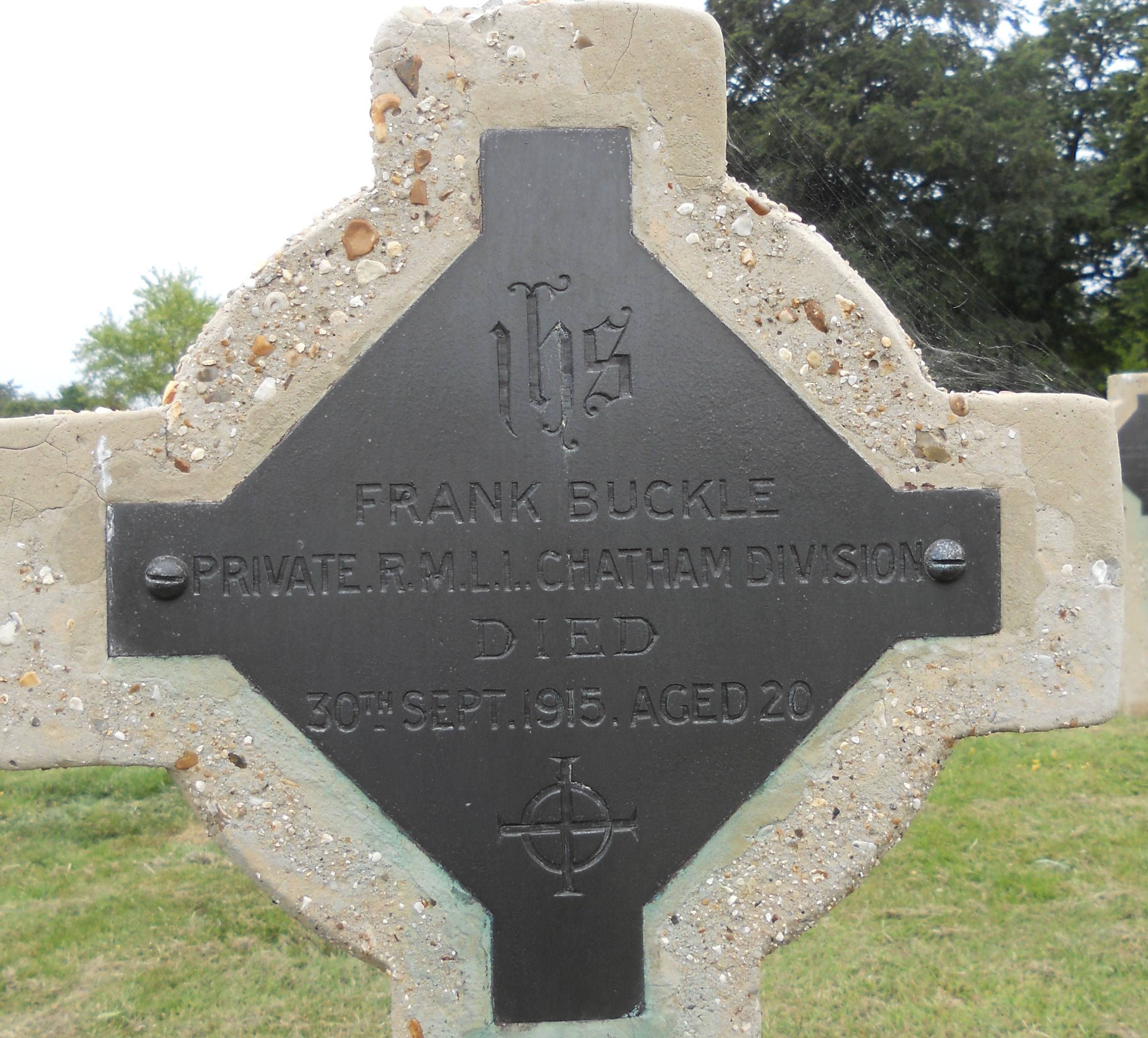
frank Buckle's grave in Haslar, near Gosport

Frank Buckle’s grave in Haslar, near Gosport

Since starting “Wokingham Remembers” I have begun to visit the graves of those men remembered on the memorial and this has taken us to different areas in search of the stories of Wokingham men. Seeing the places the men fought and died can be quite sobering but of course today few traces of the war remain and there is some wonderful countryside to be enjoyed. I will try to tell a little about those places then and now and perhaps inspire others to visit.
About 15 years we met a man (Michael Stedman) on our campsite on the Somme, he had just written a wonderful guide book “Thiepval”  part of  Battleground Europe  series. We bought our first guidebook and over the years have added the whole series to our collection!  Small areas are thoroughly examined and the battles fought there explored. There are always car tours and walks in the books and many of these walks have become family favourites. We have learnt so much from these books and the release of a new one is the excuse for another holiday!
We try to get out and walk as much as possible. To see the ground from the viewpoint of the ordinary “Tommy” and to experience the diverse weather conditions there do give one a tiny feeling of what they endured. Our children have grown up spending holidays studying the first world war and I think must have been greatly influenced by them as they are now an Army Officer and a History researcher ! We have made many friends through our travels , there is quite a considerable ex-pat community on the Somme and in the Ypres area and many, many others who spend whole seasons out there , writing and researching or just remembering.

Finding the family

A great many people in this country will have a relative who died along the Western front and a really interesting project can be to find his grave or memorial and to find out a little about what he was involved in prior to his death. Here the Commonwealth War Graves Commission  will be an essential tool. On their marvellous website are listed all the men and women who died in the 2 world wars and have CWGC graves. This is the vast majority of those who died. The website is very easy to use and combined with other search tools such as Ancestry and Find my past can help build up a proper family tree of a casualty.

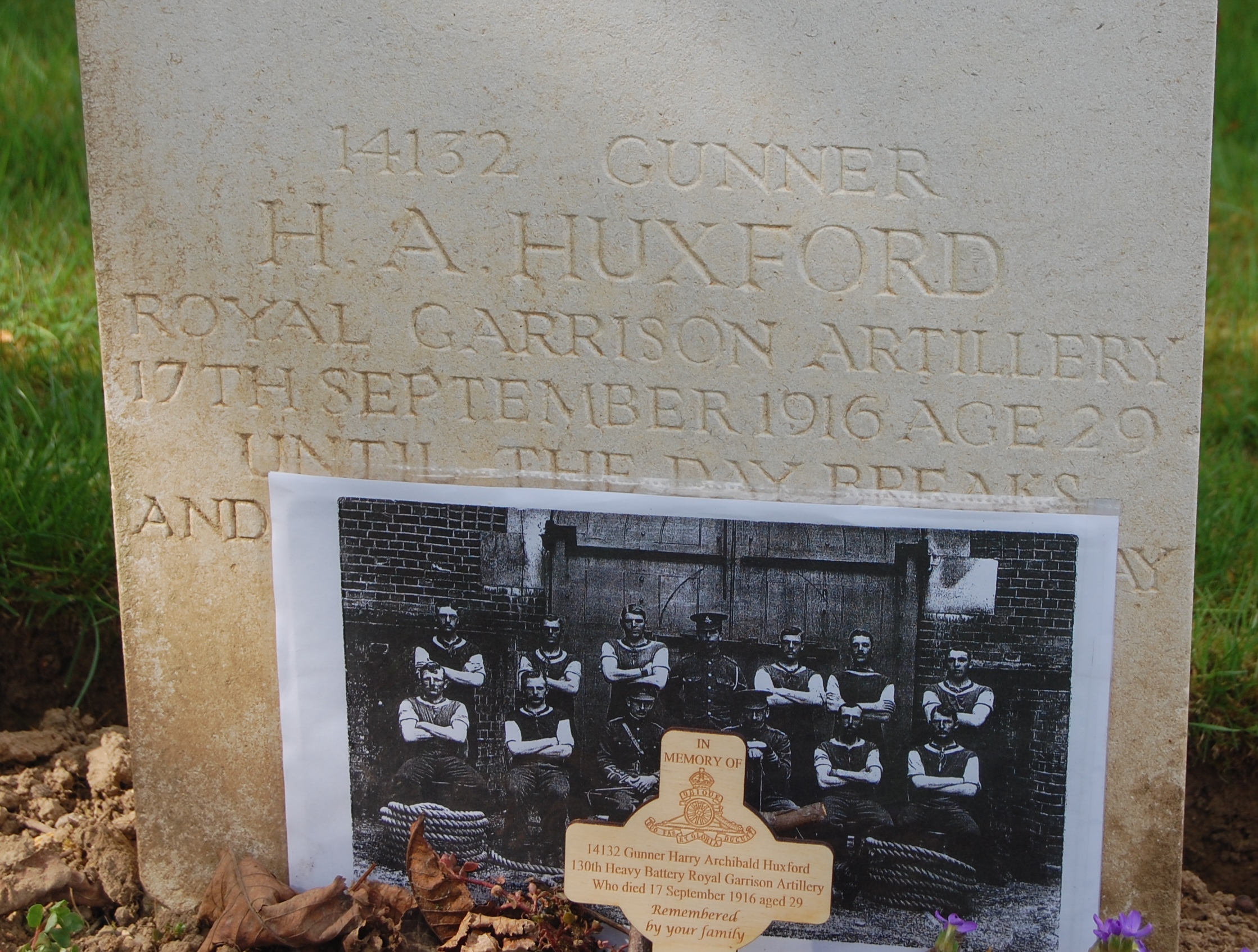
Uncle Harry Huxford's grave at heilly station cemetery

Uncle Harry Huxford’s grave at heilly station cemetery

We found a great-uncle of my husband’s buried on the Somme and eventually saw the actual war-diary entry of the day he was killed, at the National Archives in Kew. We found out what he was doing (laying a telephone cable) and where he was injured. We know where he died (at a casualty clearing station) and the route he was evacuated back along (the train line west from Albert). We visit his grave each year and he is remembered with pride .

My grandparents actually met each other (albeit briefly) whilst both serving in the Dunkirk area in 1918 and although I’ve hunted I cannot find any remnants of the hospital where they were both stationed.
So family history research will take most of us back to a member of the Armed forces who fought in the First World War.

Visiting today

Over the years there has been a general increase in the number of visitors to the battlefields, certainly France and Belgium. A great many secondary schools now travel there for a short visit and see the main memorials and cemeteries. We have seen many new memorials erected many by the Western Front Association  to remember various units and actions. Museums and interpretation centres have opened too, allowing many people an understanding of the war. Those in Peronne and at Thiepval are but 2 in the Somme area. Belgium is also well catered for by a wonderful museum and visitors centres.

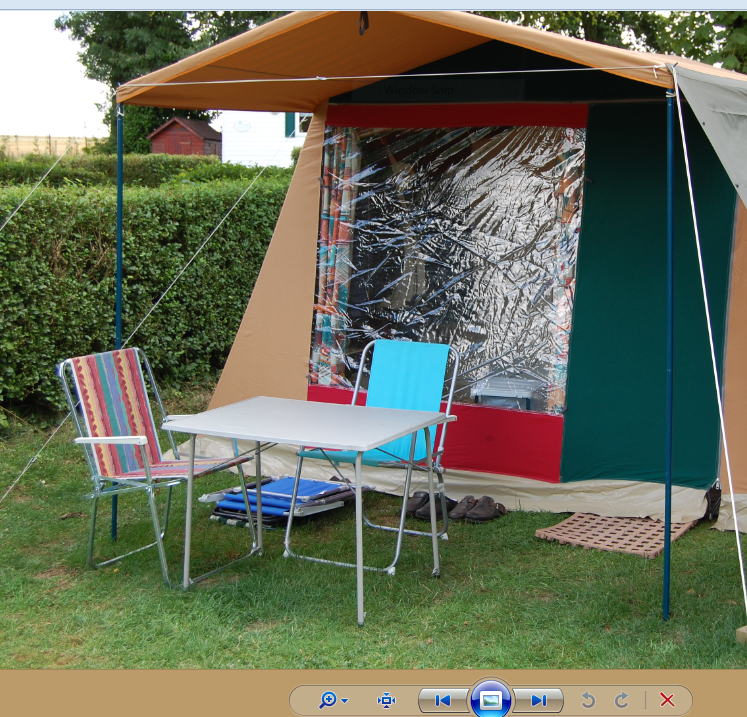
The tent !

The tent !

Further afield Gallipoli and Asiago have their own very fine local museums often run by the children and grand-children of the founders ,who probably stared with a schoolboy collection of artefacts at the end of hostilities.
It has surprised me just how many people are still interested in this war and who want to see the places for themselves. The local population in most of the places we visit are actually not that interested, but obviously happy that tourists come and those we’ve met throughout Europe are welcoming. We usually take our tent, but there a number of hotels and bed and breakfast establishments in all battlefield areas, most patrons speak some English and lots are ex-pats and thus very helpful with all tourist needs.

Posted in All Posts, Visits to the Front | Leave a comment

Cecil and Ken in Conversation 1996. By Jim Bell

Cecil Culver 1910 - 2009

Cecil Culver 1910 – 2009

Jim Bell: “Cecil’s reminiscences are taken from three interviews by his old friend and historian, Ken Goatley. The first two were recorded on audio tape in 1996 when he described his life and reminisced about Wokingham during the first twenty-five years of the 20th century. The second was on video in 1999 when he again reminisced about everyday life during this period. I have integrated both reminiscences to avoid loss of information”.

Ken—Today I’m going to be in conversation with Mr. Cecil Culver, a long time resident of Wokingham, speaking of his reminiscences of his life in the town, and the general behaviour of people and the way of life. So Cecil, where would you like to start? With cars or something of that sort?

Ken Goatley writer and historian, interviewed Cecil Culver on Wokingham in the 20th Century in 1996 and again in 1999.

Ken Goatley writer and historian, interviewed Cecil Culver on Wokingham in the 20th Century in 1996 and again in 1999.

 Cecil—No. I think this is designed to show people how things were in Wokingham at the almost turn of the century—conditions that prevailed and the way people lived. And I think there are two things that one should bear in mind as a kind of background to our talk and that is—in the first place there were no cars whatever in Wokingham when I first came here in 1914. And another thing is that there was no electricity at all in Wokingham until 1925. So whatever we tell one another, we’ve got to remember that these two things just hadn’t arrived. I think the best place to start, to give people an idea of what went on in Wokingham, is to start with, perhaps, the youngsters at school.

Posted in All Posts, Cecil Culver's Wokingham, Jim Bell's Wokingham History, The Ken Goatley Interviews | Tagged , , | 1 Comment

1919: The British keep fighting.

Uncle Jack Files Finnis. Died fighting for the White Russians 1919. His body returned 9 years later,

Uncle Jack Files Finnis. Died fighting for the White Russians 1919. His body returned 9 years later,

For most of us there is a settled feeling that the Great War came to a nice clean end at 11 am on the 11th November 1918. Admittedly, thousands of men were killed that morning and there are instances whereby some were killed after that time by an hour or two, but all in all, it was a fairly clean break. It was therefore with some consternation that I found a member of our family, a submariner, being killed during hostilities in the Baltic Sea in 1919. The enemy for the Royal Navy this time not the Germans, but our former allies the Russians; or the Bolsheviks to be precise. And our allies? The White Russians and the Estonians.  Britain was still dreaming of control of the seas and this time the bogeymen were the Communists who were going to prevent the free trade of all ships on the Baltic. On the basis that our friends are the enemies of the enemy, we struck up with the White Russians and thereby Britain enmeshed itself in a Russian Civil War. Needless to say this was a failure, but the story has more than a few twists and turns.

The L55, the ship that wouldn't die. Sunk twice and on the Black Sea after 95 years

The L55, the ship that wouldn’t die. Sunk twice and on the Black Sea after 95 years (click to view)

The L55 was a British submarine first launched in September 1918 and played little part on the Great War, but in 1919 was sent out to engage with two Bolshevik destroyers which were laying mines to protect Petrograd. The L55 unloaded its torpedoes and missed both targets and in so doing was pressed towards an area riddled with British mines. The L55 was sunk and the Bolsheviks claimed the kill, although there is a strong possibility the loss came by way of ‘friendly fire’ i.e. via Britain’s own mines. Whichever way, it was the end of our family member Stoker First Class, Jack Files Finnis, aged 28. It was not the end of the L55 though and not the end of Jack’s story either; roll on another seven years.

The L55 is raised from 100 feet in the Baltic Sea. The Russians are in search of submarine technology

The L55 is raised from 100 feet in the Baltic Sea. The Russians are in search of submarine technology

In 1926, a trawler came across the old wreck and by 1927 Russian minesweepers confirmed the find.  The now established Bolshevik government was on the hunt for new submarine technology and in 1928 announced it had successfully lifted the L55 out from a depth of over 100 feet of water. The British, aware that 42 of its souls were on board at the time of the sinking, requested the return of the bodies. This was agreed by the Russian Government, but the return would be made on to a merchant vessel as the Russians refused to have any of Britain’s destroyers in its waters. As the 34 coffins were transferred from the Truro to HMS Champion in Reval, Estonia, the local brass band played ‘Nearer my God to thee’ and the town’s flags were lowered to half mast.

The coffins on board HMS Champion make their way to England

The coffins on board HMS Champion make their way to England

The return of the bodies to England became caught up in the continuing grief of the time. The Unknown Warrior represented the servicemen from the Western Front, but now the population had 34 named sailors to grieve over.  The coffins returned with great ceremony and were buried in a communal grave in the Royal Naval Cemetery Haslar in Gosport on the 7th September 1928. Two short films can be seen of the return here: Return 1 and here: Return 2. Whilst the men were laid to rest, for the L55 it was the chance to live a second life and with it, like a story straight from the mind of Stephen King, came the opportunity to kill again.

The funeral service in 1928 created a surge of national mourning for those lost in the Great War.

The funeral service in 1928 created a surge of national mourning for those lost in the Great War.

After a refit of some one million roubles, the L55 became a member of the Russian Navy and having given up many of her technical secrets, spawned a new L class of submarines for the Bolsheviks. ‘Rebranded’ the JI-55 and renamed ‘The Atheist’, the now Russian submarine entered trials in 1931. After nineteen days she sank yet again and this time took 50 lives with her. She was still not to rest and was again recovered, this time off Kronstadt. The Athiest became a training craft until 1941 when she was again damaged before being scrapped in 1953, although there is another date of 1960. The ship which raised the L55 still roams the Black Sea under the name of ‘The Kommuna’. Originally named the Volhov, she will be celebrating her 100th birthday in 2013.

Henry Joseph Finnis 1855 - 1925. Saw the deaths of 11 of his 15 children.

Henry Joseph Finnis 1855 – 1925. Saw the deaths of 11 of his 15 children.

Jack’s family story twists and turns almost as much as the L55. When discovering the lost servicemen in our family tree, I always look more closely at the parents. Did they die before or after their son’s death, who were the siblings and what life did they have? Jack had a dad called Henry whose young brother was a Robert. The family were traditionally nautical and came from the coastal town of Deal, near Dover in Kent. After their father died and mother disappeared, the brothers decided to move, making their way around the coastal waters, into the River Thames and eventually stopping at the tides end of Teddington. In 1911 Henry had fifteen children and including Jack, he saw eleven of them die before him. Jack’s uncle Robert had five sons; four were to die in the Great War and my son is the descendent of the only survivor, an Old Contemptible who, despite several serious injuries, made his way through the entire war from start to finish.

Rupert Hammersley, born in 1894 and died on the L55 aged 25.

Rupert Hammersley, born in 1894 and died on the L55 aged 25.

In November 2013 we were contacted by Judith Pearson, the grand daughter of another victim of the sinking of the L55. Judith tells us:

My Grandfather Rupert Hammersley went down with this ship. He was born in 1894 in Hanley Staffordshire, then was living in Leicester when he married my grandmother Lillian. My mother was just one year of age at the time and grandmother brought her up alone with help of family. My mother Winnifred was their only child and passed away 2 years ago in December 7th at age 93″.

Posted in All Posts, Aspects of War | Leave a comment

The local historians who pointed to Wokingham’s Future

Edna and Ken celebrate their 50th Wedding anniversary.

Edna and Ken celebrate their 50th Wedding anniversary.

Edna Goatley passed away on Wednesday the 3rd April 2013 at the age 86 years. Her funeral takes place at Easthampstead Crematorium on Thursday 18th April at 11am.

By Mike Churcher

This is not an obituary, the Wokingham Times already provides a very good one: Click here to read it. Our page today  examines the contribution Mr and Mrs Goatley made to our understanding of Wokingham’s culture in the twentieth century and it is clear their first priority was accuracy. Edna stated in her introduction to the 2006 edition of ‘Bygone Days,’ that it is “important to have a true account of a town’s history”. During this discussion we will consider some of the difficulties and dilemmas local historians face when attempting to construct the real story of their local environment. It will also be an opportunity for us to present the vital role local historians play when providing the colour which turns a town into a community; a place where you don’t just live, but belong.

The front page of Ken's book 'The Town of my life'.

The front page of Ken’s book ‘The Town of my life’.

Edna and husband Ken spent many years examining and discussing Wokingham’s heritage; telling not the stories of Kings and Queens and pomp and ceremony, but those of ordinary people. They told the story of us; the shops, the buildings, the personalities, the simple process of daily life and how Wokingham became the place it is today. As we (Wokingham Remembers) make our way through old books and newspapers, it is hard to capture that personal touch which acts as the bridge between ourselves and the local servicemen of the Great War. The type of news reported at the time of war, tends to be on minor incidents or accidents or reports of tea parties, council decisions and an occasional reference to a death. Local historians however, are a vital part of the story telling process, bringing to life the bland newspaper reports and the higher level views and opinions of the national academics. It was Edna who gave us a story of the Great War which turned out to be the only single personal contact we have made with one of our soldiers. Edna provided home help to two old sisters from the Rideout family. She told us this story:

This is probably the photo Edna Goatley was describing. Charles Rideout is the young man wearing the apron on the right hand side. Circa 1912

This is probably the photo Edna Goatley was describing. Charles Rideout is the young man wearing the apron on the right hand side. Circa 1912

“The Rideout laddie is in a photograph I should have when the shop under me was a harness maker; he worked there before being called up. I was home help to his two sisters who died over 40 years ago. They talked of the last words he said to them; “look after Mum & Dad, because I won’t be back”. He was going back to the front line and knew of his chances of making it home again”.

Piena Eccles, the god-daughter of Ken and Edna, described them as Mr and Mrs Wokingham and the description sums up what local historians can mean to a community. To extend the metaphor; if they were Mr and Mrs Wokingham then their children were the town and it’s people.

Always there to help others: Sarah looks through Mrs Edna Goatley's WW1 records

Always there to help others: Sarah looks through Mrs Edna Goatley’s WW1 records

The psychologist, Alice Miller described the greatest parental love is for it to be unconditional; i.e. the ability to give everything without expecting anything in return. Ken and Edna provided their Wokingham with that undying, unconditional love. They gathered their information; they ensured its accuracy, they honed their famous talks and peppered them with personal anecdotes and photographs collected over many years.  They gave talks to any organisation who wanted their services, but their favourite times were in telling their stories to the children.

Not only were they able to galvanise the pride of local people in their environment, but they also acted as the kernel and inspiration for others to write their own observations of our history. Jim Bell, who has written nearly 30 short books on Wokingham looked to Ken for advice in the early days.  He tells us:

“When I was starting to write I told Ken Goatley that one of my biggest fears was producing a booklet with mistakes, he replied by saying that one produces a book to the best of one’s knowledge and ability. That book in turn gives others an opportunity to add information or to correct errors thereby perfecting our knowledge of our country’s history. It is a continuous process”.

Adam Smith, editor of the Wokingham Times in 2006 described Ken and Edna as something of a guiding light for the paper, providing the reporters with a knowledge of the town they could never receive from their employers. During these visits Ken would also ensure that any proposals which he believed would be to the detriment of the town were ‘fully explored’ by the Times reporters !

This attractive terrace of shops was replaced by the concrete and steel shops opposite the Town Hall.

This attractive terrace of shops was replaced by the concrete and steel shops opposite the Town Hall.

Historians have opinions, like anyone else and probably have more of them than most others. They compare one period with another, or they will challenge our perceptions not only of the past, but of who we are today. Historians are therefore inevitably emotional and those with experience make their points with passion, but without rancour. Ken and Edna remained stoic and philosophical in the face of the vast changes Wokingham went through in the latter half of the twentieth century.

A slightly different angle, but you get the picture !

The same spot as the above photo, as it looks today.

However, they continued to give their love and affection to a town which David Lee (Council Leader) some years later admitted in his talk of 2010 ‘was dying’.  This was their dilemma, to criticise what it was they loved so dearly. They were powerless to stop the self-inflicted damage to the town and yet they continued to tell the story without hesitation..

In homage to Edna and Ken’s contribution to Wokingham’s culture, we will in the coming weeks be providing a transcript of a number of conversations which took place about Wokingham in the twentieth century. It is an important document and was constructed with the aid of  Edna, Ken and their great friend Cecil Culver who died in 2009 (Ken himself had already passed away in 2006). Jim transcribed this enlightening set of interviews, which tell us of life in Wokingham during the inter-war years.

The Courtyard restaurant in the Town Hall today. Photo: waag.co.uk

The Courtyard restaurant in the Town Hall today. Photo: waag.co.uk

There is a final story, which clears away any suspicion that Ken and Edna just wanted to roll back the years and see the past through rose tinted glasses. In the late nineties, the Town Hall used the large hall facing Denmark Street as a place to house an occasional market. I remember it as a rather glum affair and before long a restaurant was built inside the room and tables and chairs were placed in the pedestrian area. The restaurant was called the Courtyard. Ken was known to object to this change of use and deplored the conversion. After a few years, the Courtyard established itself and it became a favourite spot for the town’s visitors to sit and together watch the world go by. Ken to his credit surveyed the Courtyard’s busy chatter and stated he was wrong, this is what the town was all about, people getting together and having fun. I hope this is a true story, because it perfectly reflects their approach; that Ken was prepared to change his mind if he saw something happening for the benefit of Wokingham.

The Goatley’s were historians, they loved their town, they were a vital part of its soul  and we’re going to miss them.

Posted in All Posts, Jim Bell's Wokingham History, Matters of Opinion, Story of Wokingham | Leave a comment

Another casualty of the Great War: Wokingham’s Mayor.

Town Hall just after the end of The Great War circa 1920

Town Hall just after the end of The Great War circa 1920

Our focus on the government of the Great War tends to be at national level, but Jim Bell’s extensive research has enabled us to look into local government from a Wokingham viewpoint. His latest book ‘Memories of the Town Hall’ was published last week.

This article takes a brief snapshot of the Mayor’s actions during the war and emphasises the point that many others apart from the Fallen became casualties. We take these casualties to be loved ones, family and friends, but there were also the administrators of the local community who together experienced close knit and life long relationships. 

Henry Charles Mylne was re-elected as Wokingham's Mayor in 1914.  His colleagues believed his early death was due to the uncesaing effirts he made throughout the period.

Henry Charles Mylne was re-elected as Wokingham’s Mayor in 1914. His colleagues believed his early death was due to the unceasing efforts he made throughout the period.

We are still collecting information on Wokingham’s war years and at the moment it is strangely, somewhat spartan. We are lucky to have the Reading Standard’s excellent photographic record of the many killed and wounded, but the newspaper stories of the time ran very silent about the war itself. The news blackout of the war and a refusal to print stories which were obvious propaganda, were good reasons why there is little to access nowadays, but there may well have also been a good helping of ‘out of sight out of mind’.

As the war was being fought away from the country, the people could carry on much as normal and therefore we could expect to see communities split into two; those who had family at war and those who did not. Is this how the population of Wokingham felt? Probably not; Wokingham had a population of less than 4,500 and of the hundreds of family trees we have built up of the time, we know that many of them interconnected many times over. Therefore, it wasn’t just parents who felt the loss, but also uncles, aunts, cousins and second cousins too. Conversations around the town would have concentrated on whether or not there was news from the Front. As we build our knowledge of the town’s traders, we are also discovering just how many of their children and their employees were sent to war. On every trip to the shops there would have again been the regular conversation of how they were doing and the inevitable news of the losses. There is no doubt Wokingham would have felt the war very deeply and on a daily basis, not only the agony of loss, but also of the depressing anxiety of not knowing if their loved one would be next.

How did the local Council handle this unprecedented situation? The Council was unsurprisingly pro war, but there is a sense that it was for duty’s sake rather than the tub thumping call to arms that has often described the first months of conflict.

The Mayor proclaims the George V as King in 1910. Both men were to face extraordinary challenges in the coming years.

The Mayor proclaims the George V as King in 1910. Both men were to face extraordinary challenges in the coming years.

The Mayor, unlucky to be in position at the time of the outbreak was Henry Charles Mylne. He had the responsibility being both the voice of the government and the people at the same time and with no precedent to guide him as to what to do. H C Mylne was born in Edinburgh and with his wife Edith and daughter Emilia, lived in the large Staverton House at 25 Murdoch Road Wokingham. By 1911 he was a retired Civil Engineer and Mayor of Wokingham. Being Mayor at the outbreak of war put a great strain on him as one of his duties was to decide on whether or not men should be sent to war or held back for their skills in vital trades. At this point we do not know of the outcome of these decisions, but he would undoubtedly have had many sleepless nights worrying about them. He was also highly active in raising funds for the servicemen and was acknowledged as the driving force in raising remembrance funds after the war. As the men drifted back from war in 1919, many of them were in a terrible state and this again would have been very distressing for him.

Mayor H C Mylne lived in Staverton House in 1911. As a public servant he gave up a good life in retirement and his friends believed the stress of the Great War killed him a few after the victory celebrations of 1919.

Mayor H C Mylne lived in Staverton House in 1911. As a public servant he gave up a good life in retirement and his friends believed the stress of the Great War killed him just a few months after the victory celebrations of 1919.

On 21st October 1919, just a few months after Wokingham’s victory celebrations, Henry died.  When the St Paul’s Memorial was consecrated in 1922, Councillor Philip Sale stated that ‘when the tablet was erected in that hall, he would press for the name of Mr. Mylne to be inscribed thereon, for his work during the war had undoubtedly hastened his end’ (Reading Mercury 1922).

Councillor Sale had taken over the running of the memorial fund following Mr Mylne’s death, probably because he too had experienced the trauma of the war. He was the owner of a local business and one of his employees Clarence Trill, was killed and named on the same memorial. When the Memorial was finally opened in the Town Hall in 1924 Councillor Sale again stated that the pressures of the war brought about H.C. Mylne’s early death.  The delay in building the memorial came out of the council’s difficulty in agreeing how best to spend the money which had been raised by the local community. A memorial had been agreed, but there was also a need for a Comrades Club, which would have enabled returning soldiers to come together in mutual support. They needed it; many were mentally and physically disabled and found comfort only in the company of those who understood.

Wokingham had a great party to celebrate the end of the War in 1919. Not all the townspeople would have been in a festive mood, least of all Henry Mylne.

Wokingham had a great party to celebrate the end of the War in 1919. Not all the townspeople would have been in a festive mood, least of all Henry Mylne.

Although it was felt there was a more pressing need to care for the wounded men, what eventually won the day was the future: a children’s hospital. The old Methodist building at the bottom of Denmark Street was purchased and converted into the Orthopaedic Clinic and ran successfully for many years.

Mayor H C Mylne’s experience demands great sympathy, but it also tells us of the very close relationship the townspeople and the Council had in running Wokingham for the collective good. Much of the funds at that time were raised by the good will of local people and therefore this relationship was vital if the town was to progress as a unit.

1st November 1919 Reading Mercury:

THE LATE ALDERMAN MYLNE

 ‘At a parochial meeting of All Saints’ held on Thursday last week, in the Church House, the Rector (Rev. B. Long), who presided, made feeling reference to the loss sustained by the death of Mr. Henry Charles Mylne, and proposed a resolution expressing the deep feeling of the meeting at the loss which as individuals and the Church in that place they had sustained, placing on record the recognition of and gratitude for the great benefit from the example of his life and the devotion of his time and powers to the service of God and the welfare of his fellows. Respectful and heartfelt sympathy was extended to Mrs. and Miss Mylne.

   Admiral Eustace referred to the late Mr. Mylne as not only a great citizen but a friend to them all.

   Mr. Hammond, a member of the Town Council, said he had known Mr. Mylne for nearly ten years, and he was sure that if ever a man laid down his life for his town and country that man was Mr. Mylne.

   The resolution was carried by a silent, standing vote.

   The Rector then offered prayer, commending the soul of the departed to God, and asking the comfort and blessing of God upon the bereaved relations.’

Jim Bell’s book tells us much more of how this relationship developed and gives an insight into how the councils grew from small, under funded meetings in the Parish vestries and into the powerful organisations we experience today. You can pick up a copy of Jim’s book at the Information Centre in the Town Hall for the very un-princely sum of just £3. Here is a list of further reading material about the life and times of Wokingham:  http://www.wokinghamsociety.org.uk/wokingham_publications.html

Posted in Aspects of War, Jim Bell's Wokingham History, Story of Wokingham | Leave a comment

1919 Victory ! Wokingham celebrates.

Father Frederick is reunited with his son outside his Peach Street shop in Wokingham. Son Henry served throughout the full course of the war

Father Frederick is reunited with his son outside his Peach Street shop in Wokingham. Son Henry served throughout the full course of the war

Local Historian, Jim Bell unearths this extensive coverage of Wokingham’s Armistice Celebrations:
“On Saturday, Wokingham duly celebrated the peace. The proceedings commenced at 7 a.m., when peals were rung on the church bells. At 10 a.m. the town band commenced to play in the Market Place. The officers and men who had been invited to send in their names and had received a card of invitation from the Mayor, assembled in Rectory Road and at 11.30 commenced a triumphal march through the principal streets of the town under command of Admiral J.B. Eustace, assisted by Colour-Sergeant H. Harvey, 4th Royal Berks. Retired, the only man who wore the old red volunteer uniform, and acted as chief marshall. Headed by the Wokingham Military Band the procession proceeded through Broad Street, which had been extensively decorated, the trees and lamp posts being bedecked with national colours, evergreens etc. A large wreath in the centre of the street. “Our bold and brave heroes, 1914-18.” Was saluted by the column.Peace 1919 Wokingham Broad Street
A triumphal arch had been erected by the corporation from the London and County Bank to Mr. T.M. Welch’s premises, bearing the words “We thank you.” Rose Street was also very gaily hung with flags and streamers, with the motto “Welcome Home” suspended across the street. As the procession emerged from Rose Street against All Saints’ Church the bells rung a peal of welcome. Marching up Peach Street, the procession entered the Market Place through an arch similar to that in Broad Street, but bearing the words “Well done boys.” The Church Lad’s Brigade bugle band were in the centre of the procession and took turns with the military band in providing music.
The wounded and disabled who were accommodated in two wagons immediately behind the leading band everywhere most heartily greeted.
Crowds 1919 Peace celebs Upon a draped and coloured dais in the Market Place, facing Denmark Street stood the Mayor in his robes attended by the Town Clerk, the mace bearer (Sergeant Sparkes), the town crier (Mr. J. Taylor) and the four honorary constables. There were also upon the platform the Mayoress, the Rev. B. Long, the Rev. H. M. Walter, the Rev. A.P. Carr and Rev. J. Conolly, Aldermen Hughes and Sale. Councillors Hammond, Martin, Blake, Whaley, Priest, Brant, Bodle and Headington. Mr. C.W. Marks (surveyor), Colonel Walker, Mayor Hanbury O.B.E., Mrs. Murdoch, Mr and Mrs. W. Howard Palmer, Mrs. H. Walter, Mrs. Eustace, Mrs. Hanbury, Miss Hanbury, Mrs. T.W. Heelas, Miss Sturges, Miss Gregorie, Mr. A Rasey and Mr. William Palmer.
The cadet band KRR sounded the Royal salute. The Mayor (Alderman Mylne) announced that he had received from H.M. the King, a message to all magistrates and lord lieutenants of counties. The National Anthem was then sung, led by the band, Mr. Yould conducting.More peace celebs 1919
The Mayor then said, ”Officers and men from the Navy, Army and the Air Force, it is my privilege as Mayor and speaking for all the people of Wokingham to bid you all welcome here today and to render to you our unstinted thanks for all you have done, all you have suffered and all you have gone through in these last few years. We rejoice that it is at last possible for us to meet so many of you after all the hardships you have gone through, since that day in which each one of you took his part in the magnificent response which you made to your country’s call in its hour of need. Some of you have been in the navy or army since the beginning of the war. Some of you were in that first army that went to Belgium—an army which I have heard has been called ‘a contemptible little army’: small it certainly was, but there is not a man in the world today, least of all in Germany, who would venture to call it contemptible.
Others of you who took part, leaving all in that mighty rush of men which changed the British Army from being reckoned in thousands to being reckoned in by millions. You, who have been through it, know what the sacrifices have been. You know even how thin a line, once and again, there was that there was all there was left to withstand the German onrush. You know, too, how indispensable it was that H M Navy should keep a ceaseless and sleepless watch throughout all the time.
decorated float waiting in Rectory Road 1919What would our position have been today if that thin line had given way or that ceaseless watch failed for one hour? What sort of peace should we have had today? What would have been our condition? Some of you have been in France and Belgium and you know and can answer that question. But that ceaseless watch was maintained till the last hour and that this line never broke, and when today we are celebrating peace, it is that great and glorious victory, brought about in the providence of God through the valour of the sailors, soldiers and airmen of the British Empire. But in the midst of our rejoicings let us not forget the sacrifices that have been made. Let us not forget that there are some hearts in the Empire today because of those who, to gain that victory and to win this peace laid down their lives and their names live for ever more.

In 1915, Wokingham received 2,500 soldiers into the area. Wokingham's population  itself was only 4,500. Few of the men looking out of this photo would have survived the conflict. Click on picture to view full image.

In 1915, Wokingham received 2,500 soldiers into the area. Wokingham’s population itself was only 4,500. Few of the men looking out of this photo would have survived the conflict. Click on picture to view full image.

When we have celebrated this peace today, which we hope will soon spread the world over, let us all stand united as we have done in those dreadful days of war in the last five years, and each in his own part, do whatsoever in him lies, to promote the common good and to bring back with peace prosperity to our native land build up a greater, more honourable and a more powerful Britain than the world had ever known before so that the victories of peace will be no less worthy of celebration than the victories of war. And now we ask you to accept our hospitality and entertainment and we hope that for you and to all of us it may be a happy and a memorable day.” (applause).
“Land of Hope and Glory” was then sung, the sole being taken in unison by some 20 choirboys, the assembly led by the band joining in the chorus. Miss Edna Martin presented a lovely bouquet to the Mayoress. The Rev. B Long called for “three cheers for the boys,” which were heartily given also “three more for their wives.”
Photo: Frederick Caiger of Peach Street, welcomes home his son Henry who saw service through the entire war, was wounded and became a Sergeant.

Posted in All Posts, Aspects of War, Jim Bell's Wokingham History | Tagged , , , , | 3 Comments

WW2 Garth: Wokingham’s Destroyer

Jim Bell provides us with a fascinating insight into Wokingham’s contribution to World War Two. Here we learn of how the local people raised hundreds of thousands of pounds to ‘sponsor’ HMS Garth throughout the latter part of the war. The efforts built a close bond between Wokingham and its adopted destroyer and culminated in the presentation of a nazi flag recovered from a captured u boat. This ship was chosen because its name was the same as the local Garth Hunt. Here is the story:

[iframe_loader width=”675″ height=”550″ frameborder = “1” longdesc=’ ‘marginheight=’0′ marginwidth=’0′ name=’ ‘click_words=’ ‘click_url=’ scrolling=’yes’ src=’http://wokinghamremembers.com/wp-content/uploads/2012/09/garth1.pdf’]

Posted in All Posts, Articles on World War 2, Aspects of War, Jim Bell's Wokingham History | Tagged , | Leave a comment