Remembrance Day – The Incredible Story

BBC coverage of Remembrance Day 2012. Photo of the Cenotaph in Whitehall, London.

Written by Mike Churcher

As we stand for the first of the two minute’s silence at 11 am, we try to contemplate those who fought and fell during all wars in all circumstances. The second minute is spent thinking about the lives of those the fallen have left behind. It is an enormous undertaking and one that many historians have spent their whole lives considering. So what chance the rest of us? We might think of a single person; I think of my 22 year old Uncle Basil who died in the second war and then his mother who lost both of her sons. Just placing myself in her house in Norfolk when she first heard the news helps me  with the enormity of the task of collecting my thoughts.

But how did this all take place; the silence, the Cenotaph, the Unknown Warrior or even Poppy Day? The history of Remembrance is a schizophrenic story, its symbols of peace have their origins steeped in the mist of the Great War; remembrance didn’t just occur, it was fought for, argued over and its general shape hammered out in the years even before the carnage of the Somme in 1916. Before the rituals of remembrance could be enacted, the Army was required to completely overhaul its administration of the dead.

Kitchener’s recruits were from all walks of life and the families expected respect for their dead.

The fervour of recruitment during the end of 1914 was making way for the grim reality of 1915. The British Army had already been virtually destroyed and the rest of the war was to depend on the civilians from Kitchener’s recruitment drive. These weren’t the grizzled warriors who had toured the continents, but the workers from farm and factory, whose parents had carved out what they hoped would be a different future. And when their boys were killed, the family did not want their bodies discarded, they wanted them home again. A small industry began to emerge, investigating the missing and searching for the bodies of dead sons, digging them up in the most perilous of circumstance and bringing them back home to loved ones. The experience of the famous Gladstone family however, would have a long term impact upon the repatriation of the rest of the dead. The 29 year old Lt William Gladstone was killed on the 13th April 1915; he was not just another statistic of war, but the grandson of one of 19th century’s most revered Prime Ministers. The bodies of some two dozen officers had already been sent back to England prior to Gladstone and it was money and patronage that had ensured their safe return. Lt Gladstone’s body was also returned and with a certain amount of pomp and circumstance. During the whole of the war however, not one body was returned who had been from the rank and file; as a result there arose disquiet mutterings of abuse of power and wealth. If Britain was to win this war it would be up to the rank and file to deliver it and the Government were fully aware of the need to keep the people ‘onside’. There were many practical problems with repatriation, exhuming the bodies was a dangerous activity, soldiers could be killed.  Other questions started to emerge, if everyone had the right to have the body returned just who would receive it, the mother or the wife? Ownership of the body lay with the Army, not so once it had been returned. And what if only parts of a body were returned? It was bad enough that an officer’s blood stained uniform was returned to the family, but body parts would have been too awful. The decision was made that no bodies would be repatriated and they would be buried in the place where they fell. In past times, soldiers came from the poorest classes, from families seeking relief from the destitution of their existence, one less mouth to feed and whilst their love was no less great there was some acceptance of those never returning. Even had they objected, the poor had no voice to represent their appeals.

Bodies of the dead from the Battle of Waterloo were treated appallingly. Here is a set of teeth which were taken from the dead and rebuilt as dentures.

In the past the bodies were in fact treated appallingly. During the Battle of Waterloo, 50,000 soldiers were buried and their bodies plundered for the new young teeth which would be used for the production of dentures. Ladies of the 19th century who could afford to buy these replacements, would be complimented for their ‘Waterloo smile’. Even as late as the 1860’s these practices were still popular, with teeth supplied by the barrel load from the fields of America’s Civil War. If the removal of the teeth from the dead was not bad enough, the bones would also become useful, being ground down and used for feeding the soil. Exactly 100 years later, there was emerging a different world, the bodies were becoming sacred, people wanted them returned, they wanted them remembered.  Organisations grew in the Great War which lobbied for their return and whilst they were never successful, the Government knew something had to be done. A great debt is owed to Fabian Ware, a soldier with experience of the South African war and a witness to the degradation of the local military cemeteries. He was to become the driving force for the emergence of the Imperial (now Commonwealth) War Graves Commission and responsible for the respectful burial of the war dead. However, before the CWGC could go to work on carrying out the wishes of the families, the Army would need to reform its treatment of the bodies and much work had to be done in just identifying who was who.

Caring for the graves at Abbeyville, just after the end of the war

Although officers were given the respectful burial they deserved in past conflicts, not so the rank and file whose bodies were just ploughed into mass graves. At first the soldiers wore red identity discs (dog tags) which were removed on death and this started the process of taking their name from the payment register. However, once the tag had been removed, how would the body be identified ? The mass graves ensured this was not important, but changes were now required to be made. It was not until September 1916 however, that two discs were provided; the red, as before for administrative purposes and a new irregular shaped green one to stay with the body for correct identification. The Battle of the Somme, which had started before this directive, (the infamous 1st July 1916) had approximately 100,000 men missing without bodies and 50,000 bodies without names.  If you tour the cemeteries on the Somme, you will find walls of names of the missing surrounding unknown graves headed only ‘Known unto God’. As the war proceeded, the soldiers themselves took some control in having their bodies identified should they be killed and it is a particularly poignant thought. Many of the bodies that lay in no-man’s land had started to decay and even the newly made cemeteries themselves were being bombed, thereby disturbing those ‘at rest’. The identity discs, being made of leather fibre would possibly rot and therefore the equally decaying body would lose its identity.

Henry Allingham’s identity bracelet. Metal bracelets and neck tags were purchased by soldiers to ensure their bodies could be identified if left for years unfound.

Many of the soldiers, knowing they too could be left to decay in no-man’s land decided to produce identity discs made of metal, which potentially gave them a better chance of retaining their own body’s identity. It is harrowing to think that these man would be worrying about their bodies after their death, believing that they too would be left un-found and forgotten. Possibly even more upsetting is that these identity bracelets were requested of and supplied by the soldier’s own parents.

The story of the Commonwealth War Graves Commission (CWGC) is strangely uplifting and its existence became a source of comfort to the parents and even the soldiers themselves. Haig was a great advocate of the idea, knowing that his men’s morale was of the utmost importance in view of the human carnage they were witnessing on a daily basis. As the instruments of state started to wield some control over the care of the dead, the next challenge would be how to mark their passing once hostilities had drawn to a close.

Over a million British and Commonwealth servicemen had died during the course of the war and only those buried in home soil were as a result of returning as either sick or injured. By 1919 the CWGC was now assisting in clearing the battlefields and preparing the bodies for a decent burial in the mass cemeteries we see today. Thousands of mourners and tourists were visiting the sites and local communities were planning their own ways of remembering the dead. Some were building hospitals, memorial halls and monuments, but what was the national government to do ? How could such an enormous cataclysmic event be encapsulated in a simple, single, brilliant idea? It didn’t come easily, but eventually three icons of remembrance were to emerge; the Cenotaph, the two minute silence and the Tomb of the Unknown Warrior.

Although we recognise November 11th as the date of remembrance, it was in fact an armistice, a time when fighting was halted. The end of the war was only declared after the signing on the Treaty of Versailles on the 28th June 1919 (the exact date when Archduke Ferdinand was murdered five years earlier).

Sketch of the Cenotaph by Lutyens.

Victory celebrations in London needed to have a focal point and Lloyd George called upon Edwin Lutyens to offer some advice. The idea of a temporary structure to be built in Whitehall was conceived by Lutyens who drew up the approximate concept during lunch. The idea was a Cenotaph, a temporary structure, which was erected in Whitehall, London. It became an instant success with a million visitors paying their respects and laying their wreaths at this empty tomb. The uncorking of such human emotion did not go un-noticed across the road in Parliament and MP’s soon called upon the structure, then made of wood and plaster, to become permanent and rebuilt in stone.

Victory day was an enormous success, but what to do with November 11th 1919? There was now the Cenotaph to act as a focal point, but what event could take place which would symbolise the act of remembrance and have national coverage? One observer of the war noticed that when coffins of the dead passed by a crowd, a hush would descend upon it, so why not a moment of silence? A letter appeared in the Times. In spite of the protestations of King George V who thought it unworkable, a two minute silence was called for on the 11th November 1919.

Trains, boats and vehicles would all stop and the people stilled and silenced into contemplation; the first minute for the dead and the second for the families still living. It worked to a point, but there was still something missing; there was no grave for the mourners to visit and even if one existed, it was faraway on the continent. Back in 1916, Reverend David Railton had seen a grave marked as containing an ‘Unknown Soldier’ and it gave him an idea which he retained for the rest of the war. An unknown soldier should be brought home who would represent all soldiers unknown and buried miles from home. It wasn’t until June 1920 that his idea finally connected, following a copious amount of correspondence with politicians and fellow clergymen. Four unknown British soldiers from the battles of Ypres, Somme, Aisne and Arras were exhumed and presented to Brigadier General L J Wyatt, who was blindfolded and taken to the coffins where he laid a hand upon one of them. The chosen soldier was taken through France, passing by thousands of French mourners and led by a line of one thousand school children. The carriage was the same one which brought both home both Edith Cavell and Charles Fryatt and its roof painted white for easy identification during its journey. The heavily laden symbolism continued as it was placed aboard HMS Verdun, named after the battle which was brought to an end by the British attack at the Somme. The cortège continued throughout the 7thNovember attracting thousands of mourners en route to Westminster Abbey where he was laid to rest on Remembrance Day, 11thNovember 1920.

Tomb of the Unknown Warrior, so called to cover all the services not just that of the soldier.

One hundred winners of the Victoria Cross, one hundred wounded nurses and one  thousand mothers and wives of those fallen attended the service. His body was laid amongst the kings and queens of Great Britain, beneath a black slab of Belgian Marble and the only tomb upon which visitors to the Abbey are not allowed to stand. The impact of his arrival was immediate. He symbolised the return of the men to all mothers and wives throughout the country, many even believing that it was their own loved one placed in this tomb.

Remembrance Day was complete except for one final story, the Red Poppy. It seems shocking to us now, but on their return from war, the ex-servicemen were not treated as heroes, but shunned and seen as competition for jobs. The war had ensured that Britain’s markets had collapsed when its global customer’s sought alternative suppliers. The result was a scrabble for jobs to feed the mouths at home and the unions responded badly to the returning heroes. Many were left to wander from town to town in search of work and became resentful that women had also stolen ‘their jobs’ – it was not the land fit for heroes as had been promised and the men were angry. Historically, such rejection was not uncommon, the British sailors who fought off the Spanish Armada were held back from port and died off shore from starvation and disease. The grateful nation did not possess the funds to pay them and some of the ships’ Commanders made the payments themselves to the few who were left. British soldiers were also the subject of fear, they were hardened warriors now and the times were unsteady with revolution becoming pandemic across Europe. Money needed to be raised to support the servicemen if tragedy was to be averted and the newly formed British Legion, with Douglas (now Earl) Haig at its helm was to become instrumental in providing some of the relief required. As we now know, the seeds of Remembrance often came from experiences of the early part of war and the poppy is of that ilk.

John McCrae ‘In Flanders Fields’. We are the Dead

A Canadian officer, John McCrae had observed the poppies during the Second Battle of Ypres in 1915. Wild flowers often emerged from the mud, but poppy seeds in particular can lie under ground for years and will not germinate until the earth is disturbed. McCrae, sickened by death and yet inspired by the glorious colours of the poppies, then wrote ‘In Flanders Fields’. The poem was at first published anonymously, but by the time of his death in January 1918 he was famous enough to receive accolades and wreaths, one of which was made from poppies. A remarkable sequence of events then took place. The idea of poppies sold to raise money came from a Moina Michael who ensured the poppy emblem was taken up by the American Legion. A French woman, Anne Guerin observed this and used the idea to raise money to help rebuild the areas of France devastated by war. By 1920 the idea had been presented to the British Legion’s Earl Haig who quickly declared that all members should

Ex servicemen making poppies. Severely disabled, it was often the only job they could find.

wear a poppy on Remembrance Day. He was held in such high esteem that his words were to spread like wild fire across the nation. The Legion, unsure of its success initially ordered 1.5 million artificial poppies, but such was its popularity that shortages took places and prices were soon fetching £5 a piece. A total of 9 million poppies were eventually supplied across the country. It was a staggering response raising in 1921, £106,000 (£4 million today). In 1922, the Legion employed 41 severely disabled war veterans to produce the poppies at a rate of 1,000 pieces a day. The appeal for 1922 however, required not the 350,000 they could make but 30 million! By 1930, the Poppy Appeal was raising £600,000 (£30 million) a year, using local labour to produce them and 90% of the net income going straight to the Benevolent Fund. What makes this enterprise so outstanding was that this was achieved during one of the lowest points in our economic history.

The making of Remembrance Day is a very human story of people from all walks of life trying to find ways to help the families of then and now, come to terms with the shocking experience of war. Local memorials continued to be built throughout the 1920’s laying down the names of those who never returned and this website attempts to tell of their life’s experience from Wokingham’s perspective. War memorials are so omnipresent throughout our towns and villages it is easy for them to become anonymous, but not so with Remembrance Day. Although it is difficult to encapsulate in two minutes the enormity of remembrance, the 11th of November remains a day close to the hearts of millions.

‘IN FLANDERS FIELDS’ by JOHN McCRAE 1872-1918 

In Flanders fields the poppies blow
Between the crosses, row on row,
That mark our place; and in the sky
The larks, still bravely singing, fly
Scarce heard amid the guns below.

We are the Dead. Short days ago
We lived, felt dawn, saw sunset glow,
Loved and were loved, and now we lie
In Flanders fields.

Take up our quarrel with the foe:
To you from failing hands we throw
The torch; be yours to hold it high.
If ye break faith with us who die
We shall not sleep, though poppies grow
In Flanders fields.

Posted in All Posts, Aspects of War | Tagged , | Leave a comment

What was in the Wokingham news during the Great War ?

The Reading Mercury (see Arborfield Local History Society)

These articles are all taken from one of the area’s principal newspapers, “The Reading Mercury (also including Oxford Gazette, Newbury Herald and Berks. County paper)”   Each week the towns and villages surrounding Reading had sections in this paper devoted to their news.

As early as Saturday the 8th August 1914 the paper showed a large map “The European War, showing the countries engaged in the great struggle and adjacent continental countries”.

 The war had not greatly affected the communities yet and news from Wokingham concerned news from the Town Council:

“The Borough Surveyor submitted his final apportionments of the expenses incurred in the making-up of Wescott Road, Goodchild Road and School Road”.

Advertisements that week included:

“Life is not to live but to live well”, an advert for Beechams pills “an unequalled cure for many of the ills that afflict the human race”.  Marvellous !

The Saunders-Hewitt Motor and Aviation Co. Ltd of Wokingham advertised: “The Renault- the finest car in the world from £208”

“The Belsize-the king of small cars £225-ready to drive away”

“The Ford….admittedly the best value ever offered, 4 seater (fully equipped) £135”

An advert for a local school:  “Grosvenor House School, Wokingham. Boarding and day school for girls. Principal Miss Baker assisted by well qualified staff. Resident French Mistress. Special painting classes. Kindergarten and transition form under the management of a trained Kindergarten Mistress. Playing field, Tennis “

The school latterly became the White House School and had been situated in Montague House at one time.

Situations vacant included:

“An attendant with some knowledge of nursing wanted to attend an elderly Gentleman and assist with light household duties; personal character necessary. Mrs Gotlee, Wokingham”

Other items include “the abandonment of the Shinfield and Grazely flower show, on account of the war now taking place “

Hurst annual show was to take place however and would feature “Wokingham Red Cross band, dancing in the evening and exhibitions of poultry and rabbits. Sports including tug-of-war”

Posted in All Posts, Aspects of War, Jim Bell's Wokingham History | Tagged , , , , | Leave a comment

Chemical warfare starts October 1914.

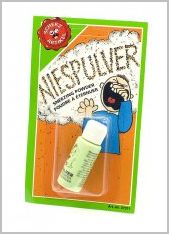
‘Niespulver’, sneezing powder was used against the Allies in October 1914

Chemical warfare enters in October 1914. Sneezing powder. The Germans used 3,000 shells containing the Niespulver, mixed with shrapnel and sent over to the British and Indian troops at Neuve Chapelle. Although not highly effective (the British were not even aware of it being used) this early attempt was aimed at causing discomfort and irritation. Tear gas had even been used by the French in small quantities as early as August 1914.

It was an inauspicious start to the campaign of chemical terror and no wonder April 1915 during the Second Battle of Ypres, is the preferred date of its introduction. Chlorine was to prove a greater success than the Germans themselves would realise and they failed to take advantage of the reverses the French and British made upon its arrival. The British themselves at the Second Battle of Ypres were pre warned of the imminent attack as an earlier break through into some German trenches found gas cylinders to be lying about abandoned. Due to some of the previous low impact of earlier strikes, the British were expecting to be able to fan it away without realising this was an entirely new chemical. Reports amounted to some 5,000 casualties on the Allied side.

During the course of the war approximately 3,000 chemicals were to be tried in the

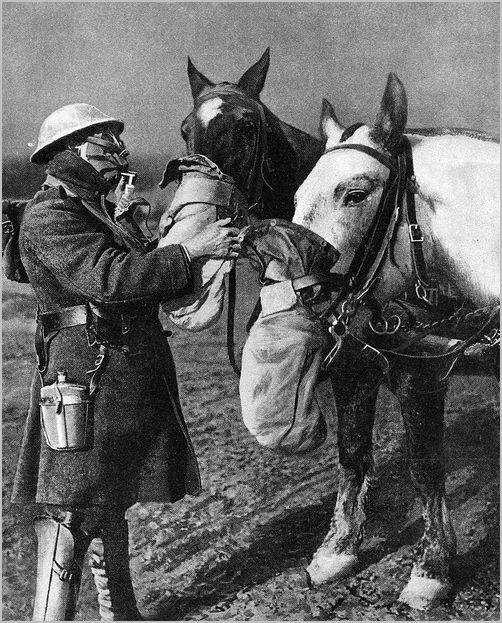
It was not only the soldiers who needed gas masks. From Great War Photos

development of this type of warfare and the Hague’s ban was therefore largely ignored. More was to follow; in the May of 1915 the Russians were to receive an even greater attack by the Germans in which 6,000 Russians were to be killed by the mass attack and again later when a further 25,000 casualties were to suffer. In the October on that year, the Germans were to send over 550 tons of chlorine at Rheims. During the Battle of Loos the British were to retaliate with a bombardment of 150 tons of chlorine, but like the Germans at Ypres, failed to capitalise by adequately supporting the attack. Two lessons had been learned by both sides; the wind change could reverse an attack and also a coordinated gas and subsequent infantry attack could be very successful.

During 1916, chemicals became more effective as Phosgene Chlorine was introduced and 18 times more potent than its predecessor. This was then followed by Diphosgene, which was more effective on the lungs creating a choking effect, had a tear gas element and was more persistent in the trenches.  Then in 1917, the Germans, who led in this particular field all through the war, introduced a new idea, mustard gas. Why was it called ‘King of the Gases’? It was more vicious certainly, but it’s true talent was ubiquitous nature. Within six weeks of its introduction in Ypres July 1917, it took 20,000 casualties. By being absorbed in the skin, it could create internal blistering although it was more famous for its temporary or permanent blinding effects. By lying on clothing and foot ware it could be walked into dugouts and trigger its effects on the unsuspecting inhabitants. Areas, which had been hard won, could not be occupied as the gas was left as booby traps. Mustard Gas was a new weapon of terror amongst the rank and file. There was another ill effect it had on morale. As mustard gas had a tendency to attack the sweatier parts of the body, the Scots regiments were eventually discouraged from the use of the kilt.

Although not thought to be an immediate killer (around 6,000 British were killed by its effects, less than 1% of fatalities) the gas is believed to have been a major killer over the years after hostilities ended in 1918. There are powerful arguments which state that to maim was more effective in the art of warfare, as it resulted in a greater consumption of resources than death itself.

DULCE ET DECORUM EST

Bent double, like old beggars under sacks,
Knock-kneed, coughing like hags, we cursed through sludge,
Till on the haunting flares we turned our backs
And towards our distant rest began to trudge.
Men marched asleep. Many had lost their boots
But limped on, blood-shod. All went lame; all blind;
Drunk with fatigue; deaf even to the hoots
Of tired, outstripped Five-Nines that dropped behind.
Gas! Gas! Quick, boys! – An ecstasy of fumbling,
Fitting the clumsy helmets just in time;
But someone still was yelling out and stumbling,
And flound’ring like a man in fire or lime . . .
Dim, through the misty panes and thick green light,
As under a green sea, I saw him drowning.
In all my dreams, before my helpless sight,
He plunges at me, guttering, choking, drowning.
If in some smothering dreams you too could pace
Behind the wagon that we flung him in,
And watch the white eyes writhing in his face,
His hanging face, like a devil’s sick of sin;
If you could hear, at every jolt, the blood
Come gargling from the froth-corrupted lungs,
Obscene as cancer, bitter as the cud
Of vile, incurable sores on innocent tongues,
My friend, you would not tell with such high zest
To children ardent for some desperate glory,
The old Lie; Dulce et Decorum est
Pro patria mori.

More about Wilfred Owen

Posted in All Posts, Aspects of War | Tagged , | Leave a comment

Winnie the Pooh and The Great War

Written by Mike. I’m not sure why we did it, but in 2003 my wife and I drove across Canada with our four year old son.

White River, Ontario (Thanks to Larry’s Canoe Journal – click to read)

It was a strange journey which included a 1000 miles of prairie land, bears racing us along the Trans Canadian Highway and our car blowing up in the forests of western Ontario. One of the many quirky moments included coming across the true story of Winnie the Pooh and her contribution to the First World War. It started off when we stopped off at a small town called White River half way between Sault Ste Marie and Thunder Bay ….

Harry Colebourn and Winnie on Salisbury Plain, England

In August 1914, Harry Colebourn a vet from Winnipeg Manitoba, was on his way to the Western Front. Lieutenant Colebourn was born in England in 1887 and emigrated to Canada at the age of 18. As with many Canadians born in England, there was still a close attachment to the ‘old country’ and Harry immediately volunteered to serve. White River had been built as a stop off point by the Canadian Pacific Railway in 1885 and became an important trading centre; it was also the place where Harry stayed whilst on his way to England and France. It was here he came across a trapper who had a young black bear to sell, having killed the mother. The area had a number of bears owned by local people and White River was a good market where a very good price could be fetched. Harry paid $20 for the bear, being worth over $400 today in 2012.

Little did Harry know that this $20 was going to affect millions of children around the world. A sequence of events now takes place.

Harry was a part of the Fort Garry Horse Regiment at the time and they were well equipped to transport horses across the Atlantic in support of the war effort. Plus a small black bear it seems. Harry had by this time made up his mind about the name of the bear. He had found a home in Winnipeg, Manitoba, and decided to name the bear Winnipeg, or ‘Winnie’ for short.

Just down the A303 (M3 from Wokingham) are the Salisbury Plains, home for many of the soldiers training for war across the Channel and home too for Harry, his Regiment and also the fast growing Winnie. An affectionate bear and well loved by the troops, Winnie was nevertheless growing at the kind of pace that black bears do and the playful climbing of the tent poles were becoming an increasingly dangerous piece of playtime japes. A decision was going to have to be made as it was becoming clear that trench life was not going to suit Winnie or any of the soldiers who might be in close proximity. Harry therefore lends Winnie to London Zoo in December 1914, promising to return to collect at the end of the war. Winnie became such a star at the zoo, that Harry turned the loan into a gift in 1918. Winnie was the only animal allowed to play with children and would lick jam off their hands as a special trick.

As the crowds grew and Winnie’s name achieved national recognition, a man and his son decided to join the queue. AA Milne and his son Christopher Robin were so taken by the sight of Winnie that they started to make up stories about the bear on returning home. Christopher Robin had a bear called ‘Edward’ which was immediately changed to Winnie and his pet swan also donated his name, ‘Pooh’. Winnie the Pooh was now the subject of AA Milne’s stories and the rest we know. Winnie was to live at the zoo until her death in 1934, aged 20. Fame had already spread further after the Winnie the Pooh stories were first published in 1926, but did Harry make it through the war? Yes he did, returning to visit Winnie whenever he could until her death. Harry died in 1947 aged 60.

Alec Somerville from Canada has added his knowledge of the Winnie story: “Writing as a Canadian – I was always under the impression that ‘Winnie’ was a lone bear cub found alongside the railway at Wawa, Ontario, by the Winnipeg Fusiliers, who were on their way to France. They brought the cub with them as a mascot and named him ‘Winnie’. It has always been said that Milne was an Officer in the Army Educational Corps who saw ‘Winnie’ in the Canadians’ camp, where he was teaching… ‘The Pooh’ comes from the then-common Army expression ‘a Poo-bah’ meaning a useless regular Army Officer whose main claim to fame was ‘that he had served in Poonah…’ which he repeated interminably… ‘When I was in Poonah…’”

Posted in All Posts, Aspects of War | Tagged , | Leave a comment

Bearwood Roll of Honour, St Catherine’s Church.

Click on Picture to increase size.

Every now again we come across seemingly small pieces of information, which suddenly provides insights into the changing attitude to the war. At first it was about glory, fighting for one’s country, beating the Bosch and still be back in time for Christmas lunch. As the war churned on, it cast a shadow upon every town in the country and the early optimism descended into the dread of the postman’s knock.

A descendant of the Potter family, Anna Matthews, very kindly drew up the list of servicemen named on St Catherine’s Roll of Honour. The list created in 1914, recognises those who left for war at the time and includes those who eventually returned.

Bearwood, St Catherines Church

“I found this memorial, which is hung on the wall of the porch in the church, particularly moving. The date that war was declared has been written on the shield on the left, but the shield on the right, for the war’s end date, is empty”.

“I know from my research that Frank Potter, my grandfather’s uncle, was killed in 1916 – and two more of his brothers were to follow. It is poignant that the Roll of Honour must have been started with much gusto and as the war dragged on, perhaps it became too painful to keep it up-to-date. By the end of the war, maybe it no longer felt worth it to inscribe the date that peace was declared”.

“The priest of the church did not appear to know about this memorial – I asked him about it and then found it myself as he could not help. I can imagine that at the start of the war, the families hung the Roll with pride and then, perhaps, as reality was too real, it was forgotten about. Perhaps it was forgotten about until I found it in 2012”.

The Roll of Honour was updated as the names of the wounded and killed came to the attention of the parish clergy. The final entry was for George Addington Hawkins, killed 27th September 1915, during the Battle of Loos, the first large scale loss of life the British had to contend with. It might be as Anna says, that the clergy didn’t have the heart to place the deaths up on the Roll, also knowing that it would challenge the morale of the parishioners.

Alfred Henry Allen – Royal Field Artillery
Alfred Arnatt – 2nd Royal Inniskilling Fusiliers
William Leslie Allnatt – RFA Motor Machine Gun Section
Ralph Ayres – Royal Engineers
George Baker
William Barnes – Army Veterinary Corps
William Norman Black – HMS Safeguard
Job Broadhurst – Army Service Corps
Alfred Bye – Army Service Corps
George Challis – Army Service Corps
Edward Challis – Army Service Corps
William James Clements – 8th Bucks & Oxfordshire
Gilbert Cook
Harry Cook
Thomas Cook [wounded]
Walter Cox
Maurice Deane – 1/4 Royal Berks
Ernest Harold Deane – Royal Army Medical Corps (brother of Maurice)
Thomas Denton – Army Veterinary Corps
Victor Denton – Army Veterinary Corps
Jack Denton – 4th Royal Berks
Charles Eamer – 2nd Royal Berks (brother)
Henry Eamer – 2nd Royal Berks
William Eamer – 4th Rifle Brigade (brother)
Thomas Wheeler Evans – 3rd Royal Berks
Enos George Farr – HMS Queen Mary
Hubert Walter Farr – 1st Royal Berks [wounded]
James Gardiner – 1st Royal Berks [killed in action]
Hugh Godsal – Royal Field Artillery
Alan Godsal – 7th Rifle Brigade [killed in action at Hooge July 30. 15]
James Goodyer – 4th Royal Berks
Percy Frederick Gregory – Royal Engineers
William Henry Grainger – Army Service Corps
Charles William Hooper – Army Service Corps
George Addington Hawkins – 12th Northumberland Fusiliers Machine Gun Section [killed in action at Loos, Sept 26.7.15]
Joseph Edward Hunt – Royal Engineers
Albert Victor Hunt – Royal Engineers
James Hunt – Army Service Corps
Alfred Hyde – Royal Army Medical Corps
Ernest Edward Ives
David Arthur Johnson – 4th Hampshire
Percy Kelsey Kaye – 6th Royal Berks, Machine Gun Section
Henry Kennedy – 3rd Royal Berks [killed in action, Dec. 1. 14]
Thomas Andrew Laney – HMS Impregnable
George Stephen Langford – 3rd Royal Berks
Hugh Philip Leach – Royal Field Artillery
Edward Robert Leach – Army Service Corps
Sidney Lovejoy – Royal Marine Light Infantry
Thomas Lunn – 3rd Royal Berks
Frederick George Lyddiatt – 4th Gloucestershire
William May – Scottish Canadian Gordon Highlanders
Guy Deacon Meadowcroft – 11th Royal West Kent
Samuel Meadowcroft
William George Middleton – Army Service Corps
Reginald Victor Millson – HMS Superb
Arthur William Godley Oates – Army Service Corps
Arthur Willam Paley – 3rd Royal Berks
George Neville Payne – Royal Engineers
Frederick Parker – HMS Illustrious
Edwin Charles Phillips – Royal Army Medical Corps [wounded]
Frank Phillips – 1st London Rifle Brigade
George Phillips – 4th Royal Berks
William Phillips – 4th Royal Berks
John Potter – HMS Jupiter
George Potter – HMS Liverpool
Thomas Potter – 7th Royal Berks
Reginald Potter – 4th Royal Berks
Percy Stephen Potter – King’s Royal Rifles
Frank Potter – HMS Powerful
John Pursey – 5th East Surrey
Joseph Pursey – 5th East Surrey
George Edward Rabbitts
George Rogers – 3rd Royal Berks
Thomas Rogers – Royal Horse Artillery
Charles Rogers – 10th Hussars
Joseph Rogers – Royal Field Artillery
Joseph Sadler – Royal Horse Artillery
Charles Sarjeant – 6th Royal Berks
William Shadbolt – 7th Queen’s West Surrey
Alfred Reginald Silver – 8th Royal Berks [wounded]
William Silver – 1st Grenadier Guards [wounded]
William Simpson – 4th Royal Berks
Daniel John Smith – 9th Leicestershire
Frederick William Smith – 2nd Royal Berks [wounded]
William Taylor – Army Service Corps
Cecil William Taylor – 3rd Royal Berks [wounded & prisoner]
Albert Henry Turner – Army Service Corps
Stephen Walter – Royal Naval Air Service
Harry Watts – York & Lancs.
Alfred Watts – Royal Marine Artillery
Joseph Watts – 7th Hussars
William Watts – 3/4 Royal Berks
George Wingfield – Royal Flying Corps
John Wingfield – Royal Flying Corps
Charles Wise – Royal Marine Light Infantry
David Yardley – 5th Royal Berks

Posted in All Posts, Aspects of War, Jim Bell's Wokingham History | Tagged , , , , | 1 Comment

BBC’s ‘Birdsong’ and the story of the miners in The Great War

Front cover of ‘Birdsong’ by Sabastian Faulkes

Birdsong has completed its two episodes on the BBC. Author, Sebastian Faulkes tells us of a story about a soldier who has been affected by the experience of war; from the battles of the Somme to Messines Ridge and Amiens. The more the battles rage the more his mind is taken back to a time when he fell in love with a French woman in the summer of 1910. The story weaves its way through the deaths of comrades on the battle field and the memories of the loss of his lover before the war changed his life and that of many others. It also delves into the experiences of a group of miners who are tunnelling under the ground taken up by German trenches. The book presents a far darker picture of the experiences of the mine workers than we have seen from its televised counterpart, which naturally tends to emphasise the story’s love theme. However, the BBC still manages to tell the story of the mines, a little known, but very important part of the war’s operations. The chalk deposits that lay around the Western Front, provided a relatively penetrable subsoil and below the streets of Arras, the town’s besieged residents have hidden in the honeycomb of tunnels for hundreds of years. Le Grande Mine site at La Boiselle shows a huge crater from an underground bomb which announced the start of the Battle of the Somme on July 1st 1916. The placement under the German lines, was the result of the tunnelling of miners taken from the coalfields of England and Wales and even workers from the London Underground.

Historian Max Arthur, produced a magnificent book titled ‘Forgotten Voices Of The Great War’ and tells the story of the war via the memories of the soldiers who were actually there. One such soldier was Lance Sergeant Charles Quinnell of the Royal Fusiliers (9th Battalion). He tells us of his observations of the miners and finishes off with one of the war’s many shocking revelations.

“Sixty men and two senior NCO’s out of each battalion had to be labourers for the Royal Engineers mining parties.

We were billeted in French barracks in Bethune and the idea was that three parties of thirty men would attend to each mine. There were three mines at Givenchy, known as Ducksbill 1, Ducksbill 2 and Ducksbill 3.

As you walked along the trench all you saw of the mine was a wooden framed doorway about four feet high and two wide. Behind it was a staircase that went thirty feet underground and opened up into a room about eight feet by eight. In the centre of that room was a four feet square shaft and over the top of that was a wooden windlass and a rope. The shaft went down another twenty feet or so. At the bottom of the shaft was another doorway facing the German Lines and that was the entrance to the tunnel. The tunnels were a continuation of this wooden frame work that went straight ahead under the German lines.

Now these lads were really masters with their tools. Their principal tool was a bayonet and they would stick that into the face then with a twist of the wrist bring out a big cheese of clay, which was put in the sandbags and passed along the tunnel to the bottom of the windlass. That was then wound up and an endless chain of men took them up the staircase and threw them over the top.

Every now and again we’d have to stop work and we’d always have one man down there at the face who’d sit on a sandbag with a stethoscope pressed against the wall, so he could hear the Germans working. If you could hear the Germans working you knew you were safe, it was when he didn’t hear a noise you knew the Germans were going to blow. One day I crept up to the chap who was listening and whispered, could I have a listen? He handed the stethoscope to me and I could distinctly hear the Germans talking.

It was clay there and while those timber frames were good, every joint leaked and as you were bending down all the time and they were only four feet high – your back got absolutely sodden because it was drip, drip, drip on you all of the time. We pumped the mine for days on end but you couldn’t make an impression on the water. The bottom tunnel was absolutely filled and it started to come up the shaft. This puzzled the Royal Engineer officer who went out one night and found a crater immediately above the tunnel. The German had been pumping water out of their mine and into this crater, so of course we were getting the full benefit of it. So he cut the German hoses and that had an immediate difference and we got our mine clear of water.

The miners were a rough lot, but by God they were brave men. They used to mooch into the trench, they had a rifle but they didn’t know how to fire it. They weren’t supposed to, they were miners. You could always tell a miner, he never bothered to clean his buttons. He was a miner, he wasn’t one of those posh soldiers.

We had a sergeant who came to us when the Dardanelles was evacuated, a very regimental type of man. On his first day in the trenches two of these miners slummocked past him along into the front line – they used to walk along with their heads down and took no notice of us and we took no notice of them. Anyway, this sergeant didn’t know who they were and yelled out “Halt !” Then when they didn’t attempt to halt, he gave the order again, but when they didn’t obey he brought up his rifle and ‘bang’, he shot the first one through the head. Then he did exactly the same to the other man, so a bullet went through both their heads. He killed them stone dead. He was later court martialled and reduced to corporal”.


Posted in All Posts, Aspects of War | Tagged , | Leave a comment

The story of The Christmas Day Truce 1914

Peace breaks out on the Western Front

Many thanks to Wiki for this study of the amazing tale of the human family’s desire to express friendship during the first Christmas of the First World War:

The 1914 Christmas truce was a series of widespread unofficial ceasefires that took place along the Western Front around Christmas of 1914, during the First World War. Through the week leading up to Christmas, parties of German and British soldiers began to exchange seasonal greetings and songs between their trenches; on occasion, the tension was reduced to the point that individuals would walk across to talk to their opposite numbers bearing gifts. On Christmas Eve and Christmas Day, many soldiers from both sides – as well as, to a lesser degree, from French units – independently ventured into “No man’s land“, where they mingled, exchanging food and souvenirs. As well as joint burial ceremonies, several meetings ended in carol-singing. Troops from both sides had also been so friendly as to play games of football with one another.[1]

The truce is seen as a symbolic moment of peace and humanity amidst one of the most violent events of modern history. It was not ubiquitous, however; in some regions of the front, fighting continued throughout the day, whilst in others, little more than an arrangement to recover bodies was made. The following year, a few units again arranged ceasefires with their opponents over Christmas, but to nothing like the widespread extent seen in 1914; this was, in part, due to strongly worded orders from the high commands of both sides prohibiting such fraternisation.

The truces were not unique to the Christmas period, and reflected a growing mood of “live and let live“, where infantry units in close proximity to each other would stop overtly aggressive behaviour, and often engage in small-scale fraternisation, engaging in conversation or bartering for cigarettes. In some sectors, there would be occasional ceasefires to go between the lines and recover wounded or dead soldiers, whilst in others, there would be a tacit agreement not to shoot while men rested, exercised, or worked in full view of the enemy. However, the Christmas truces were particularly significant due to the number of men involved and the level of their participation – even in very peaceful sectors, dozens of men openly congregating in daylight was remarkable.

Background

The first months of World War I had seen an initial German attack through Belgium into France, which had been repulsed outside Paris by French and British troops at the Battle of the Marne in early September 1914. The Germans fell back to the Aisne valley, where they prepared defensive positions. In the subsequent Battle of the Aisne, the Allied forces were unable to push through the German line, and the fighting quickly degenerated into a static stalemate; neither side was willing to give ground, and both started to develop fortified systems of trenches. To the north, on the right of the German army, there had been no defined front line, and both sides quickly began to try to use this gap to outflank one another; in the ensuing “Race to the Sea“, the two sides repeatedly clashed, each trying to push forward and threaten the end of the other’s line. After several months of fighting, during which the British forces were withdrawn from the Aisne and sent north into Flanders, the northern flank had developed into a similar stalemate. By November, there was a continuous front line running from the North Sea to the Swiss frontier, occupied on both sides by armies in prepared defensive positions.[2]

The approach to Christmas

Soldiers playing football on Christmas Day in Salonika, 1915.

In the lead up to Christmas 1914, there were several peace initiatives. The Open Christmas Letter was a public message for peace addressed “To the Women of Germany and Austria“, signed by a group of 101 British women suffragists at the end of 1914 as the first Christmas of World War I approached.[3][4] Pope Benedict XV, on 7 December 1914, had begged for an official truce between the warring governments.[5] He asked “that the guns may fall silent at least upon the night the angels sang.”[6] This attempt was officially rebuffed.[7]

Christmas 1914

British and German troops meeting in No man’s land during the unofficial truce (British troops from the Northumberland Hussars, 7th Division, Bridoux-Rouge Banc Sector)

Though there was no official truce, about 100,000 British and German troops were involved in unofficial cessations of fighting along the length of the Western Front.[8] The first truce started on Christmas Eve, 24 December 1914, when German troops began decorating the area around their trenches in the region of Ypres, Belgium.[9]

The Germans began by placing candles on their trenches and on Christmas trees, then continued the celebration by singing Christmas carols. The British responded by singing carols of their own. The two sides continued by shouting Christmas greetings to each other. Soon thereafter, there were excursions across No Man’s Land, where small gifts were exchanged, such as food, tobacco and alcohol, and souvenirs such as buttons and hats. The artillery in the region fell silent that night. The truce also allowed a breathing spell where recently fallen soldiers could be brought back behind their lines by burial parties. Joint services were held. The fraternisation was not, however, without its risks; some soldiers were shot by opposing forces. In many sectors, the truce lasted through Christmas night, but it continued until New Year’s Day in others.[7]

Bruce Bairnsfather, who served throughout the war, wrote: “I wouldn’t have missed that unique and weird Christmas Day for anything. … I spotted a German officer, some sort of lieutenant I should think, and being a bit of a collector, I intimated to him that I had taken a fancy to some of his buttons. … I brought out my wire clippers and, with a few deft snips, removed a couple of his buttons and put them in my pocket. I then gave him two of mine in exchange. … The last I saw was one of my machine gunners, who was a bit of an amateur hairdresser in civil life, cutting the unnaturally long hair of a docile Boche, who was patiently kneeling on the ground whilst the automatic clippers crept up the back of his neck.”[10]

General Sir Horace Smith-Dorrien, commander of the British II Corps, was irate when he heard what was happening, and issued strict orders forbidding friendly communication with the opposing German troops.[8]

Adolf Hitler, then a young corporal of the 16th Bavarian Reserve Infantry, was a notable opponent of the truce.[8]

Later truces

In the following months, there were a few sporadic attempts at truces; a German unit attempted to leave their trenches under a flag of truce on Easter Sunday 1915, but were warned off by the British opposite them, and later in the year, in November, a Saxon unit briefly fraternised with a Liverpool battalion. Come December, there were explicit orders by the Allied commanders to forestall any repeat of the previous Christmas truce. Individual units were encouraged to mount raids and harass the enemy line, whilst communicating with the enemy was discouraged by artillery barrages along the front line throughout the day. The prohibition was not completely effective, however, and a small number of brief truces occurred.

An eyewitness account of one truce, by Llewelyn Wyn Griffith, recorded that after a night of exchanging carols, dawn on Christmas Day saw a “rush of men from both sides … [and] a feverish exchange of souvenirs” before the men were quickly called back by their officers, with offers to hold a ceasefire for the day and to play a football match. It came to nothing, however; the brigade commander threatened repercussions for the lack of discipline, and insisted on a resumption of firing in the afternoon.[12] Another member of Griffith’s battalion, Bertie Felstead, later recalled that one man had produced a football, resulting in “a free-for-all; there could have been 50 on each side”, before they were ordered back.[13]

In an adjacent sector, a short truce to bury the dead between the lines led to official repercussions; a company commander, Sir Iain Colquhoun of the Scots Guards, was court-martialled for defying standing orders to the contrary. Whilst he was found guilty and officially reprimanded, this punishment was quickly annulled by General Haig, and Colquhoun remained in his position; the official leniency may perhaps have been because he was related to Herbert Asquith, the Prime Minister.[14]

In the later years of the war, in December 1916 and 1917, German overtures to the British for truces were recorded without any success.[15] However, in some French sectors, singing and an exchange of thrown gifts was occasionally recorded, though these may simply have reflected a seasonal extension of the live-and-let-live approach common in the trenches.[16]

Evidence of a Christmas 1916 truce, previously unknown to historians, has recently come to light. In a letter home, 23-year-old Private Ronald MacKinnon told of a remarkable event that occurred on December 25, 1916, when German and Canadian soldiers reached across the battle lines near Vimy Ridge to share Christmas greetings and trade presents. “Here we are again as the song says,” the young soldier wrote. “I had quite a good Xmas considering I was in the front line. Xmas eve was pretty stiff, sentry-go up to the hips in mud of course. … We had a truce on Xmas Day and our German friends were quite friendly. They came over to see us and we traded bully beef for cigars.”

The passage ends with Pte. MacKinnon noting that, “Xmas was ‘tray bon’, which means very good.”[17] MacKinnon was killed shortly afterwards during the Battle of Vimy Ridge.

In the following years of the war, artillery bombardments were ordered on Christmas Eve to try to ensure that there were no further lulls in the combat. Troops were also rotated through various sectors of the front to prevent them from becoming overly familiar with the enemy. However, situations of deliberate dampening of hostilities also occurred. For example, artillery was fired at precise points, at precise times, to avoid enemy casualties by both sides.[18]

French-German truce

Richard Schirrmann, who was in a German regiment holding a position on the Bernhardstein, one of the mountains of the Vosges, wrote an account of events in December 1915: “When the Christmas bells sounded in the villages of the Vosges behind the lines ….. something fantastically unmilitary occurred. German and French troops spontaneously made peace and ceased hostilities; they visited each other through disused trench tunnels, and exchanged wine, cognac and cigarettes for Westphalian black bread, biscuits and ham. This suited them so well that they remained good friends even after Christmas was over.” He was separated from the French troops by a narrow No Man’s Land and described the landscape as: “Strewn with shattered trees, the ground ploughed up by shellfire, a wilderness of earth, tree-roots and tattered uniforms.” Military discipline was soon restored, but Schirrmann pondered over the incident, and whether “thoughtful young people of all countries could be provided with suitable meeting places where they could get to know each other.” He went on to found the German Youth Hostel Association in 1919.[19]

Public awareness

The events of the truce were not reported for a week, in an unofficial press embargo which was eventually broken by the New York Times on 31 December. The British papers quickly followed, printing numerous first-hand accounts from soldiers in the field, taken from letters home to their families, and editorials on “one of the greatest surprises of a surprising war”. By 8 January pictures had made their way to the press, and both the Mirror and Sketch printed front-page photographs of British and German troops mingling and singing between the lines. The tone of the reporting was strongly positive, with the Times endorsing the “lack of malice” felt by both sides and the Mirror regretting that the “absurdity and the tragedy” would begin again.[20]

Coverage in Germany was more muted, with some newspapers strongly criticising those who had taken part, and no pictures published. In France, meanwhile, the greater level of press censorship ensured that the only word that spread of the truce came from soldiers at the front or first-hand accounts told by wounded men in hospitals.[21] The press was eventually forced to respond to the growing rumours by reprinting a government notice that fraternising with the enemy constituted treason, and in early January an official statement on the truce was published, claiming it had happened on restricted sectors of the British front, and amounted to little more than an exchange of songs which quickly degenerated into shooting.[22]

In Petermann makes peace or the parable of German sacrifice, a 1933 play by national socialist writer and World War I veteran, Heinz Steguweit, a German soldier, accompanied by Christmas carols sung by his comrades, erects an illuminated Christmas tree between the trenches, but is shot dead by the enemy. Later, when the fellow soldiers find his body, they notice in horror that enemy snipers shot down every single Christmas light from the tree.[23]

Posted in All Posts, Aspects of War | Tagged , , , | Leave a comment

A family reunites for Alfred Hurdwell.

Peter Hurdwell and Heather White, visit their ancestor Alfred Hurdwell’s memorial in Wokingham Town Hall. 2011

Although we are still adding the names of the Wokingham Fallen to our website, we have already witnessed our first reunion of two members of the Hurdwell family who were introduced to each other via Wokingham Remembers. Heather White had read about the website in the Wokingham Times and made contact with us, sending some superb photos of her ancestor Alfred Hurdwell.  Alfred was killed in action on the 22nd August 1917, during the Third Battle of Ypres; otherwise known as Paschendaele. Whilst we were building the family tree, Peter Hurdwell made contact informing us that he too was a descendant of Alfred. Peter lives in Sydney, Australia and was visiting the UK to meet up with some friends. We introduced Peter to Heather (a descendant of Alfred’s sister) and the result was a meeting of the two cousins at Wokingham’s War Memorial in the Town Hall.

L to R: Mike Churcher (Wokingham Remembers), Peter Hurdwell (Alfred’s family), Heather White (Alfred’s family), Trevor Ottlewski (Wokingham History Society), Councillor Gwynneth Hewetson (Cultural Partnership) and Jan Nowecki (Town Clerk).

Now this wasn’t two people meeting up and knocking on the door to have a look in the War Memorial Room. If the Town Council are informed beforehand, they will take a descendent visiting the memorial very seriously. The Council at this point becomes the voice of the community which expresses its appreciation of the servicemen’s gift of life. On this occasion the Town Clerk (Jan Nowecki) and Councillor Gwynneth Hewtson  (also Chairman of The Cultural Partnership) were there to greet Heather and Peter and provided an appropriately warm reception. Trevor Ottlewski  who is Chairman of The Wokingham History Society was also on hand to give the visitors a tour of the magnificent Victorian Town Hall, which is placed right in the middle of the town centre.

To cap it off and to add to the importance of the occasion, Lewis Rudd, reporter from the Wokingham Times came along to take an interview. I state that this is an important occasion because the whole event came about from a communal desire to remember a young 21 year old man from Wokingham who literally gave up his life to protect his family and ultimately our community. It is also an uplifting experience to learn of Heather’s and Peter’s desire to keep their ancestor’s memory close within their family. Heather’s own children have made the journey to the Tyne Cot Memorial in France, to mark their respect for Alfred’s memory. Peter too has made his own personal journey to the same Memorial, making the long trip from the other side of the world.

Alfred Hurdwell. There is another picture of Alfred on his own page, with Hetty Fisher, his sweetheart.

Keeping in mind the nature of the occasion, we all agreed it was an uplifting moment for us. The sun shone on the day, Wokingham was in flower and the town’s people were out in force, simply enjoying the unique atmosphere our town can provide on days such as this. And here we were, our small group, taking part in the simple act of remembering one of our fallen from the First World War and knowing Alfred would be as proud of his home town as much as we were of him.

Please take the time to look at Alfred’s page and also see him standing proudly by the side of his sweetheart Hetty Fisher,  yet another person embroiled in this personal tragedy. If you would like to know more about the events leading up to the particular action read John Chapman’s excellent synopsis on http://www.purley.eu/H142P/P274-YPRE.pdf. John Chapman is a leading expert on the Royal Berkshire Regiment, otherwise know as the biscuit boys. To read of the Regiment’s experience in the war is in itself a highly rewarding journey.

In building up our knowledge of the 217 fallen of the First World War, we can only note that Alfred’s name being remembered by his family is something of a rarity. By twist of fate, the men who died for us, were too young to have their own offspring to recall their memory by a future generation. Also, any surviving brothers returning from the war, rarely recalled the appalling experience and so the names of their dead siblings are now often lost to history. It is therefore an ambition of this project to encourage the community to ‘adopt’ one of our Fallen. He may have lived in the same street as us, or went to the same school or maybe worked in the same business, trade or shop. We can bring their names back into our lives where they belong and make sure their names are remembered at the major centenary events of 2014 – marking also, the year the world changed. We hope also to involve the descendants who have also ready made their valuable contributions to our mission.

Sarah Huxford and Mike Churcher (Wokingham Remembers)

mrchurcher@gmail.com and huxfordfamily@gmail.com

Posted in All Posts, Aspects of War, Story of Wokingham | Tagged , , , , | 4 Comments