
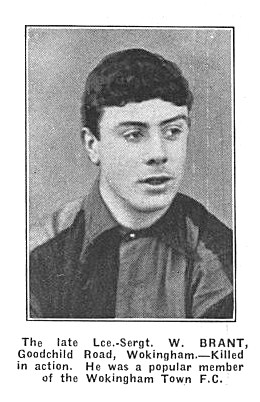
 William Brant Died 6th August 1916
Like his young cousin, William Walter Brant who died in 1914, William was from a family that could trace its connections back to Berkshire and in particular Winkfield Row, to the 1600’s. Over the centuries, the Brant family became one of the largest in Wokingham.
William was born in 1888 in Wokingham to father, Frederick and mother Ruth, nee Radbourn. They lived at 6 Easthampstead Road, Wokingham. William was the second born and had one sibling, an elder brother, Frederick John. In 1901, William’s father was a Baker and brother, a carpenter. They lived at 86 Peach Street, Wokingham. By the age of 23, William had become a house painter and was living at ‘Fairborne’ in Goodchild Road, with his brother’s family. His parents, Frederick and Ruth had already passed away in 1905 and 1908 respectively.
William joined the 5th Battalion, Royal Berkshire Regiment around August 1914. It was the first of Kitchener’s Berkshire battalions. Their Colonel describes his new recruits and by accident, provides a very good description of a class ridden, pre-war Britain:
“The keenness and enthusiasm of the men was perfectly wonderful. No hours were too long for them: they were a most intelligent lot of men, drawn from all grades of society – from an artist to a valet. We had one platoon of butlers and footmen.The footman was often promoted before the butler and the butlers seemed perfectly contented to be commanded by the footmen. Another platoon was almost exclusively composed of a peer’s gardeners or men on his estate”.
John Chapman’s excellent history of the regiment’s journey through the war, provides us with an insightful description of the battalion’s early days:
‘On the 20th September Lord Kitchener himself came to inspect the troops. He expressed himself as well pleased with its appearance and steadiness. Partly this was because any man who had not yet been properly kitted out or who was regarded as not yet up to standard was hidden from his sight. Alec Gold was one of these and told not to move out of the officer’s mess. He continued in his memories:-
“Afterwards we were sent for to the Orderly Room where we were told by the CO (Lt Col Foley) to go home and equip ourselves properly and not to come back until we were properly dressed. (our ready-made uniforms did not fit very well)”.
After nine months of training, blighted by a lack of equipment, and available officers, the battalion was ready. It was also an opportunity for bright young men to make their way up the ranks as promotion now increasingly depended on merit and not one’s civilian status.
On May 31st 1915 William had landed in France. For the next three months, they had it quite easy, but that was soon to change at Loos in the September. John Chapman again:
‘Throughout the summer of 1915 they alternated between trench duty and periods in reserve and for most men it was all a great game. When the Battle of Loos opened on 25th September they were engaged in creating diversions and uncertainty in the German lines well to the north of the main battlefield. The following day however they began a move south and were brought to grim reality by the sight of casualties and appalling conditions. They made their attack on the 13th October at Hulluch Quarry and acquitted themselves well but 65 were either killed or died of their wounds and 91 wounded, many of whom later died’.
Over the Winter of 1915, the Battalion went into trench duty and reserve, then later it was training for the ‘Big Push’ – The Somme. Chapman again:
‘They were transferred to III Corps on 16th June 1916 and made their debut at the Somme on 3rd July at Ovillers fighting over grouned strewed wit the bodies of men from the 2nd Battalion. This engagement won them 6 MCs, 6 DCMs, and 17 MMs but the Battalion was reduced to 340 men. They came under severe counter-attack on the 8th August winning another 14 MMs’.
William had survived the grisly first month of the Somme campaign, but after five weeks, he was dead. He is listed as being killed on the 6th August 1916, which was a comparatively quiet time for the 5th and he may have been a victim of the occasional pieces of trench warfare which continued in between the set battles. However, we also know that the 5th suffered a major counter attack by the Germans on the 8th August and he could we have been involved at this point.
He joined the list of fatalities along with his cousins William Walter Brant and James Bowyer.
A small piece in the Reading Mercury from September 1916 tells us ;
“Sergeant W Brant , killed in action. Formerly employed as a plumber in Wokingham. His brother F Brant has recently joined the RNAS”
BRANT, WILLIAM
Rank: Lance Serjeant
Service No: 11341
Date of Death: 06/08/1916
Age: 28
Regiment/Service: Royal Berkshire Regiment 5th Bn.
Panel Reference Pier and Face 11 D.
Memorial THIEPVAL MEMORIAL
Additional Information: Son of the late Frederick and Ruth Brant, of Wokingham, Berks.
1891: 6 Easthampstead Road, Wokingham.
1901: 86 Peach Street, Wokingham.
1911: ‘Fairborne’ Goodchild Road, Wokingham. With his brother Frederick’s family.
[iframe_loader width=”920″ height=”1550″ frameborder = “1” longdesc=’ ‘marginheight=’0′ marginwidth=’0′ name=’ ‘click_words=’ ‘click_url=’ scrolling=’yes’ src=’http://wokinghamremembersco.ipage.com/Family trees/Brant Williams’]