
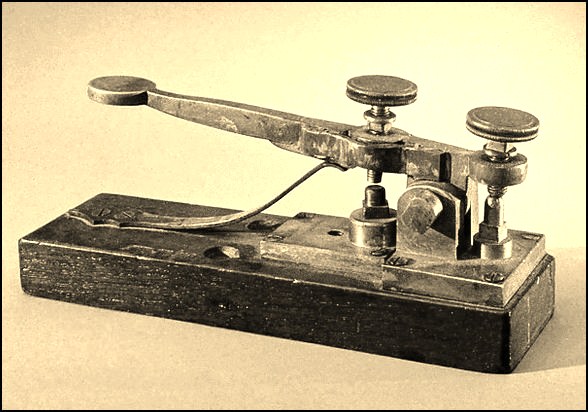
The first commercial telegraph was invented in 1837 by Sir William Fothergill Cooke and Charles Wheatstone.
Cecil – Letters and postcards was one way of communicating but it was too slow sometimes for some and if one wanted to get a message to someone else very quickly one had to use the telegraph or send a telegram and the rule for the telegram was one went to the post office and there were lots of little boxes holding these forms. One filled up a form with a message that one wanted to send and the cost was a shilling for twelve words including the address and so one’s message had to be somewhat cryptic. One couldn’t afford to put too many words down because every extra word was a penny a time. One handed the form into the post office where it was assessed, paid your fee and right at the end of the counter I remember when as a small boy seeing this chap named Daniel, a fair haired young man with his morse key sending telegrams out and receiving them back in.
I could never understand what was going on with the morse key. He did and never did a message ever go awry. One never got the wrong message. It was sent by morse key because, had one sent the message by telephone, there was always the chance that a word might get mispronounced, misunderstood and the message would be completely changed. But by doing it by morse code it was always the correct message that was received.
When it got to the other end where it had to be delivered. There again there was a messenger boy in his dark blue uniform with a pillbox hat with white piping on it and a button the top. He would be given the message note, put it in his box, climb on his bike and go off and deliver it. And it was pretty well guaranteed that if you sent off a telegram, it got to its destination within half an hour. And if you wanted a reply you had a prepaid reply. So virtually you could get a reply to any query within the hour. And that was one of the best ways of communicating because although the telephone was in existence it was in its primitive days. Very few people had it and business people and the ordinary house didn’t have a telephone.